Ch. 14 - NMR Spectroscopy
Bruice - Organic Chemistry 8th Edition
Bruice8th EditionOrganic ChemistryISBN: 9780135213711Not the one you use?Change textbook
Chapter 15, Problem 78b(4)

How many signals are produced by each of the following compounds in its
b. 13C NMR spectrum?
4.

Verified step by step guidance
1
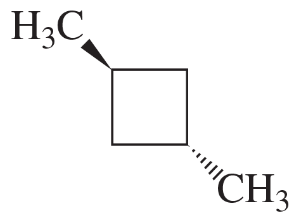
Step 1: Analyze the structure of the compound provided. The compound is an ether with a cyclic structure and an alkyl chain attached. Identify all unique carbon environments in the molecule.
Step 2: Recall that in 13C NMR spectroscopy, each unique carbon environment produces a distinct signal. Carbons in identical environments (symmetry) will produce the same signal.
Step 3: Examine the cyclic portion of the molecule. The ring contains carbons that are not equivalent due to the presence of the oxygen atom and the alkyl substituent. Count the unique carbon environments in the ring.
Step 4: Examine the alkyl chain attached to the ring. The chain contains carbons that are in different environments due to their positions relative to the ring and the oxygen atom. Count the unique carbon environments in the chain.
Step 5: Sum the number of unique carbon environments identified in the ring and the alkyl chain. This total represents the number of signals that will be observed in the 13C NMR spectrum for this compound.

Verified video answer for a similar problem:

This video solution was recommended by our tutors as helpful for the problem above.
Video duration:
3m
Was this helpful?

Key Concepts

Here are the essential concepts you must grasp in order to answer the question correctly.

Carbon Environment

In 13C NMR spectroscopy, each unique carbon environment in a molecule produces a distinct signal. This means that carbons in different chemical environments, such as those bonded to different functional groups or in different hybridization states, will resonate at different frequencies, leading to separate peaks in the spectrum.
Recommended video:
Guided course
02:12
Carbonation of Grignard Reagents

Symmetry and Equivalent Carbons

Molecules with symmetrical structures can have equivalent carbons that do not produce separate signals in the NMR spectrum. Identifying symmetry in a compound helps in determining how many unique signals will appear, as equivalent carbons contribute to a single peak rather than multiple peaks.
Recommended video:
Guided course
01:10
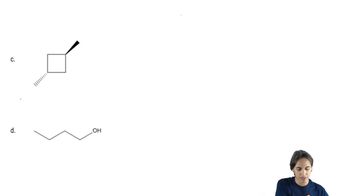
Determining Chirality with Plane of Symmetry

Integration and Peak Area

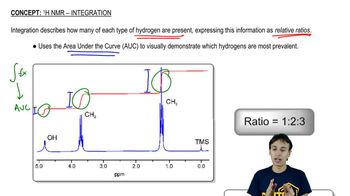
In 13C NMR, the area under each peak corresponds to the number of carbons contributing to that signal. While integration is more commonly discussed in 1H NMR, understanding that the intensity of a signal can indicate the number of equivalent carbons is crucial for interpreting the spectrum and confirming the number of signals.
Recommended video:
Guided course
06:46
1H NMR Integration