Ch. 14 - NMR Spectroscopy
Bruice - Organic Chemistry 8th Edition
Bruice8th EditionOrganic ChemistryISBN: 9780135213711Not the one you use?Change textbook
Chapter 15, Problem 4e,f

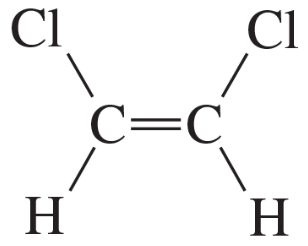
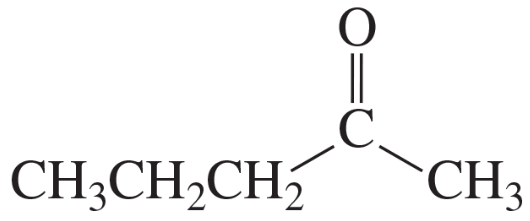
How many signals would you expect to see in the 1H NMR spectrum of each of the following compounds?
e.
f.

Verified step by step guidance
1
Step 1: Analyze the molecular structure provided in the image. The compound contains a double bond (C=C) and several chlorine atoms attached to the carbon atoms. Additionally, there are two hydrogen atoms directly bonded to the carbons in the double bond.
Step 2: Determine the symmetry of the molecule. The molecule is symmetrical about the double bond, meaning the environment of the hydrogens on each side of the double bond is identical.
Step 3: Identify the unique hydrogen environments. In this molecule, there are only two hydrogens present, both attached to the carbons in the double bond. Due to the symmetry, these hydrogens are in the same chemical environment.
Step 4: Predict the number of signals in the 1H NMR spectrum. Since both hydrogens are in the same environment, they will produce a single signal in the 1H NMR spectrum.
Step 5: Conclude that the molecule will exhibit one signal in its 1H NMR spectrum due to the identical environment of the hydrogens.

Verified video answer for a similar problem:

This video solution was recommended by our tutors as helpful for the problem above.
Video duration:
2m
Was this helpful?

Key Concepts

Here are the essential concepts you must grasp in order to answer the question correctly.

Chemical Shifts in NMR

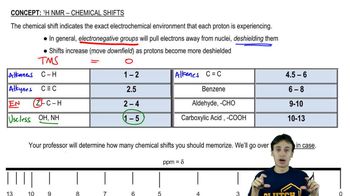
In 1H NMR spectroscopy, the position of signals (chemical shifts) is influenced by the electronic environment surrounding hydrogen atoms. Electronegative atoms, such as chlorine, can deshield hydrogen atoms, causing them to resonate at different frequencies. Understanding how substituents affect chemical shifts is crucial for predicting the number of signals in a spectrum.
Recommended video:
Guided course
11:44
1H NMR Chemical Shifts

Multiplicity of Signals

The multiplicity of NMR signals arises from spin-spin coupling between neighboring hydrogen atoms. This is described by the n+1 rule, where n is the number of adjacent protons. Recognizing how many neighboring protons each hydrogen has helps determine the splitting pattern and the total number of distinct signals observed in the spectrum.
Recommended video:
Guided course
02:02
Identifying Proton Signals

Symmetry and Equivalent Protons

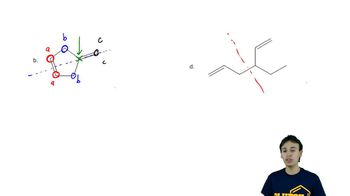
In NMR, protons that are chemically equivalent will produce a single signal. Symmetry in a molecule can lead to multiple protons being equivalent, reducing the number of signals in the spectrum. Analyzing the structure for symmetry and identifying equivalent protons is essential for accurately predicting the number of signals in the 1H NMR spectrum.
Recommended video:
Guided course
00:25
Determining Chirality with Plane of Symmetry