Ch. 14 - NMR Spectroscopy
Bruice - Organic Chemistry 8th Edition
Bruice8th EditionOrganic ChemistryISBN: 9780135213711Not the one you use?Change textbook
Chapter 15, Problem 58

Would it be better to use 1H NMR or 13C NMR spectroscopy to distinguish 1-butene, cis-2-butene, and 2-methylpropene? Explain your answer.

Verified step by step guidance
1
Step 1: Understand the structural differences between the three compounds: 1-butene, cis-2-butene, and 2-methylpropene. These differences will influence the number and type of signals observed in both 1H NMR and 13C NMR spectroscopy.
Step 2: Analyze the 1H NMR spectra. In 1H NMR, the number of unique hydrogen environments and their splitting patterns (due to spin-spin coupling) can help distinguish the compounds. For example, 1-butene has terminal hydrogens on the double bond, while cis-2-butene has hydrogens in a cis configuration, and 2-methylpropene has a methyl group attached to the double bond.
Step 3: Analyze the 13C NMR spectra. In 13C NMR, the number of unique carbon environments is determined by the symmetry of the molecule. For instance, 1-butene has four unique carbon environments, cis-2-butene has three due to its symmetry, and 2-methylpropene has three unique carbons as well.
Step 4: Compare the advantages of each technique. 1H NMR provides detailed information about hydrogen environments and coupling patterns, which can be useful for distinguishing compounds with different hydrogen arrangements. On the other hand, 13C NMR focuses on carbon environments and is less affected by splitting patterns, making it easier to count unique carbons in symmetric molecules.
Step 5: Conclude which technique is better. Since the compounds differ significantly in their carbon environments (e.g., number and symmetry), 13C NMR would be more straightforward for distinguishing these compounds. However, 1H NMR could also be used if detailed splitting patterns and chemical shifts are analyzed carefully.

Verified video answer for a similar problem:

This video solution was recommended by our tutors as helpful for the problem above.
Video duration:
6m
Was this helpful?

Key Concepts

Here are the essential concepts you must grasp in order to answer the question correctly.

Nuclear Magnetic Resonance (NMR) Spectroscopy

NMR spectroscopy is a powerful analytical technique used to determine the structure of organic compounds. It exploits the magnetic properties of certain nuclei, such as hydrogen (1H) and carbon (13C), to provide information about the number and environment of these atoms in a molecule. The resulting spectra reveal distinct signals that correspond to different chemical environments, allowing chemists to deduce structural information.
Recommended video:
Guided course
10:06
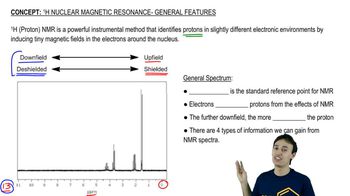
General NMR Features

1H NMR vs. 13C NMR

1H NMR focuses on the hydrogen atoms in a molecule, providing detailed information about the number of hydrogen environments and their connectivity. In contrast, 13C NMR targets carbon atoms, offering insights into the carbon skeleton and the types of functional groups present. The choice between the two depends on the specific structural features one aims to analyze, with 1H NMR often being more sensitive to subtle differences in hydrogen environments.
Recommended video:
Guided course
06:46
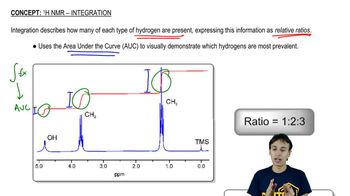
1H NMR Integration

Isomer Distinction

Isomers are compounds with the same molecular formula but different structural arrangements. In the case of 1-butene, cis-2-butene, and 2-methylpropene, their distinct arrangements lead to different chemical environments for hydrogen and carbon atoms. 1H NMR is particularly effective in distinguishing these isomers due to its sensitivity to the spatial arrangement of hydrogen atoms, which can reveal differences in stereochemistry and connectivity.
Recommended video:
Guided course
01:10
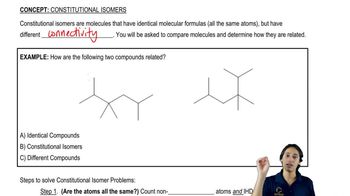
What is a constitutional isomer?