Ch. 15 - Reactions of Carboxylic Acids and Carboxylic Acid Derivatives
Bruice - Organic Chemistry 8th Edition
Bruice8th EditionOrganic ChemistryISBN: 9780135213711Not the one you use?Change textbook
Chapter 16, Problem 54

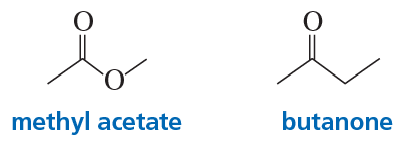
a. Which compound would you expect to have a greater dipole moment, methyl acetate or butanone?
b. Which would you expect to have a higher boiling point?
Structural formulas of methyl acetate and butanone, labeled for comparison of dipole moment and boiling point.

Verified step by step guidance
1
Step 1: Analyze the molecular structures of methyl acetate and butanone. Methyl acetate is an ester with the formula CH3COOCH3, while butanone is a ketone with the formula CH3COCH2CH3. Both compounds contain polar functional groups, but their dipole moments depend on the distribution of electron density and molecular geometry.
Step 2: Compare the dipole moments of the two compounds. The ester group in methyl acetate has two oxygen atoms contributing to its polarity, while the ketone group in butanone has one oxygen atom. The dipole moment is influenced by the electronegativity of oxygen and the molecular geometry. Consider how the electron density is distributed in each molecule.
Step 3: Evaluate the boiling points of the two compounds. Boiling point is influenced by intermolecular forces such as hydrogen bonding, dipole-dipole interactions, and London dispersion forces. Butanone, being a ketone, has a slightly larger molecular size and more surface area for dispersion forces compared to methyl acetate, which may affect its boiling point.
Step 4: Consider the functional groups and molecular weights. Methyl acetate has a molecular weight of 74 g/mol, while butanone has a molecular weight of 72 g/mol. Despite the similar molecular weights, the functional groups and intermolecular forces play a significant role in determining boiling points.
Step 5: Summarize the findings. Methyl acetate is expected to have a greater dipole moment due to the ester group with two oxygen atoms. Butanone is likely to have a higher boiling point due to stronger dispersion forces and dipole-dipole interactions associated with its ketone group and larger molecular surface area.

Verified video answer for a similar problem:

This video solution was recommended by our tutors as helpful for the problem above.
Video duration:
3m
Was this helpful?

Key Concepts

Here are the essential concepts you must grasp in order to answer the question correctly.

Dipole Moment

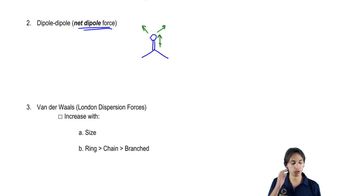
The dipole moment is a measure of the separation of positive and negative charges in a molecule, indicating its polarity. It arises from differences in electronegativity between atoms, leading to uneven charge distribution. A higher dipole moment suggests a more polar molecule, which can influence solubility and boiling points.
Recommended video:
Guided course
01:46
How dipole-dipole forces work.

Boiling Point

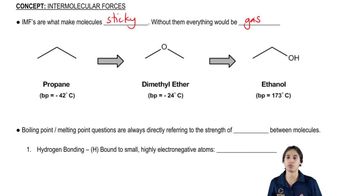
The boiling point of a compound is the temperature at which its vapor pressure equals the external pressure, causing it to change from liquid to gas. Factors affecting boiling points include molecular weight, intermolecular forces (like hydrogen bonding and dipole-dipole interactions), and molecular structure. Generally, stronger intermolecular forces lead to higher boiling points.
Recommended video:
Guided course
03:08
How IMFs are related to melting and boiling points.

Intermolecular Forces

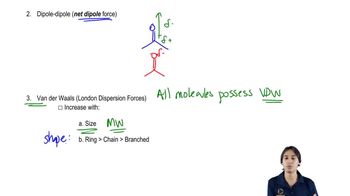
Intermolecular forces are the forces of attraction or repulsion between molecules, influencing physical properties such as boiling and melting points. Key types include hydrogen bonds, dipole-dipole interactions, and London dispersion forces. The strength and type of these forces depend on molecular structure and polarity, affecting how substances behave in different states.
Recommended video:
Guided course
03:01
How Van der Waals forces work.