Ch. 15 - Reactions of Carboxylic Acids and Carboxylic Acid Derivatives
Bruice - Organic Chemistry 8th Edition
Bruice8th EditionOrganic ChemistryISBN: 9780135213711Not the one you use?Change textbook
Chapter 16, Problem 46b

How does acetic anhydride make it easier to form the anhydride?

Verified step by step guidance
1
Acetic anhydride is a reactive compound that contains two acyl groups connected by an oxygen atom. Its structure makes it highly electrophilic, which facilitates reactions involving nucleophiles.
When acetic anhydride is used in a reaction, it can act as an acylating agent. This means it can transfer one of its acyl groups to a nucleophile, forming a new bond and releasing a byproduct (usually acetic acid).
The presence of two acyl groups in acetic anhydride increases its reactivity compared to a single carboxylic acid. This is because the leaving group (acetate ion) is stabilized by resonance, making the reaction more favorable.
In the context of forming an anhydride, acetic anhydride can react with a carboxylic acid. The nucleophilic oxygen of the carboxylic acid attacks the electrophilic carbonyl carbon of the acetic anhydride, leading to the formation of a mixed anhydride and acetic acid as a byproduct.
The use of acetic anhydride simplifies the process of anhydride formation because it avoids the need for harsh conditions or strong dehydrating agents, which are typically required to remove water in direct anhydride synthesis from two carboxylic acids.

Verified video answer for a similar problem:

This video solution was recommended by our tutors as helpful for the problem above.
Video duration:
15m
Was this helpful?

Key Concepts

Here are the essential concepts you must grasp in order to answer the question correctly.

Acetic Anhydride Structure

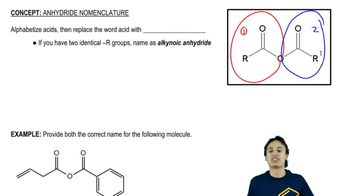
Acetic anhydride is a simple anhydride formed from acetic acid. Its structure consists of two acetyl groups (CH3CO) linked by an oxygen atom. This configuration allows it to act as a reactive acylating agent, facilitating the formation of other anhydrides by providing a source of acyl groups that can readily react with nucleophiles.
Recommended video:
Guided course
03:35
Anhydride Nomenclature

Nucleophilic Acyl Substitution

Nucleophilic acyl substitution is a fundamental reaction in organic chemistry where a nucleophile attacks the carbonyl carbon of an acyl compound, leading to the substitution of the leaving group. In the case of acetic anhydride, the presence of the electron-withdrawing carbonyl groups enhances the electrophilicity of the carbonyl carbon, making it more susceptible to nucleophilic attack and thus facilitating the formation of anhydrides.
Recommended video:
Guided course
01:47
Nucleophiles and Electrophiles can react in Substitution Reactions.

Reactivity of Anhydrides

Anhydrides are generally more reactive than their corresponding carboxylic acids due to the absence of the hydroxyl group, which can stabilize the molecule through hydrogen bonding. This increased reactivity allows acetic anhydride to easily participate in condensation reactions, where it can combine with other carboxylic acids or alcohols to form new anhydrides, streamlining the synthesis process.
Recommended video:
Guided course
03:35
Anhydride Nomenclature