Ch. 15 - Reactions of Carboxylic Acids and Carboxylic Acid Derivatives
Bruice - Organic Chemistry 8th Edition
Bruice8th EditionOrganic ChemistryISBN: 9780135213711Not the one you use?Change textbook
Chapter 16, Problem 31a

Show how each of the following esters could be prepared using a carboxylic acid as one of the starting materials:
a. methyl butyrate (odor of apples)

Verified step by step guidance
1
Identify the structure of methyl butyrate. Methyl butyrate is an ester with the formula CH₃CH₂CH₂COOCH₃. It consists of a butanoic acid-derived portion (CH₃CH₂CH₂CO-) and a methyl group (-OCH₃).
Recall the general method for ester synthesis: Esters are typically prepared via Fischer esterification, which involves reacting a carboxylic acid with an alcohol in the presence of an acid catalyst (e.g., H₂SO₄).
Determine the carboxylic acid and alcohol needed to form methyl butyrate. The carboxylic acid must be butanoic acid (CH₃CH₂CH₂COOH), and the alcohol must be methanol (CH₃OH).
Write the reaction equation for the synthesis: CH₃CH₂CH₂COOH + CH₃OH → CH₃CH₂CH₂COOCH₃ + H₂O. This reaction is catalyzed by an acid, such as H₂SO₄, to promote the formation of the ester bond.
Describe the reaction conditions: Combine butanoic acid and methanol in a reaction flask, add a few drops of concentrated sulfuric acid as the catalyst, and heat the mixture under reflux. After the reaction is complete, the ester can be purified by distillation or extraction.

Verified video answer for a similar problem:

This video solution was recommended by our tutors as helpful for the problem above.
Video duration:
3m
Was this helpful?

Key Concepts

Here are the essential concepts you must grasp in order to answer the question correctly.

Esterification

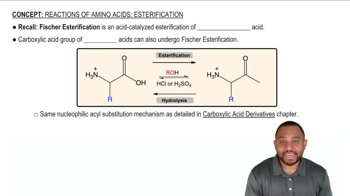
Esterification is a chemical reaction that forms an ester from a carboxylic acid and an alcohol. This process typically involves the condensation of the two reactants, resulting in the elimination of water. The reaction can be catalyzed by an acid, which helps to increase the reaction rate. Understanding this process is crucial for synthesizing esters like methyl butyrate.
Recommended video:
1:21
Reactions of Amino Acids: Esterification Concept 1

Carboxylic Acids

Carboxylic acids are organic compounds characterized by the presence of a carboxyl group (-COOH). They are key starting materials in ester synthesis, as they provide the acid component needed for esterification. The specific carboxylic acid used will influence the structure and properties of the resulting ester, making it essential to select the appropriate acid for the desired ester.
Recommended video:
Guided course
04:20
Carboxylic Acids Nomenclature

Alcohols

Alcohols are organic compounds containing one or more hydroxyl groups (-OH) attached to a carbon atom. In the context of ester synthesis, the choice of alcohol is critical, as it determines the alkyl portion of the ester. For methyl butyrate, methanol is the alcohol used, and understanding its role in the esterification process is vital for successful synthesis.
Recommended video:
Guided course
01:01
How to name alcohols