Ch. 15 - Reactions of Carboxylic Acids and Carboxylic Acid Derivatives
Bruice - Organic Chemistry 8th Edition
Bruice8th EditionOrganic ChemistryISBN: 9780135213711Not the one you use?Change textbook
Chapter 16, Problem 8a

What is the product of an acyl substitution reaction—a new carboxylic acid derivative, a mixture of two ­carboxylic acid derivatives, or no reaction—if the new group in the tetrahedral intermediate is the following? a. a stronger base than the substituent that is attached to the acyl group

Verified step by step guidance
1
Identify the type of reaction: This is an acyl substitution reaction, which involves the replacement of the leaving group attached to the acyl carbon with a nucleophile. The reaction proceeds through a tetrahedral intermediate.
Compare the basicity of the incoming group (nucleophile) and the leaving group: The outcome of the reaction depends on the relative basicity of the new group (nucleophile) and the substituent already attached to the acyl group (leaving group).
Understand the role of basicity: In acyl substitution reactions, the leaving group is typically the weaker base. If the new group (nucleophile) is a stronger base than the leaving group, it is less likely to leave the tetrahedral intermediate, favoring substitution.
Predict the product: Since the new group is a stronger base than the substituent attached to the acyl group, the reaction will result in the formation of a new carboxylic acid derivative where the stronger base replaces the weaker base as the substituent.
Conclude the reaction outcome: The product of the reaction will be a single new carboxylic acid derivative, as the stronger base remains attached to the acyl group after the substitution reaction.

Verified video answer for a similar problem:

This video solution was recommended by our tutors as helpful for the problem above.
Video duration:
6m
Was this helpful?

Key Concepts

Here are the essential concepts you must grasp in order to answer the question correctly.

Acyl Substitution Reaction

An acyl substitution reaction involves the replacement of a leaving group in an acyl compound (like an acyl chloride or an ester) with a new nucleophile. This process typically occurs through the formation of a tetrahedral intermediate, where the nucleophile attacks the carbonyl carbon, leading to the eventual expulsion of the leaving group and the formation of a new acyl derivative.
Recommended video:
1:01
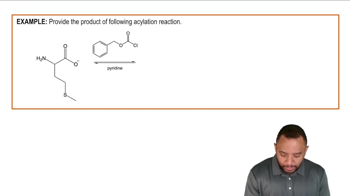
Reactions of Amino Acids: Acylation Example 1

Tetrahedral Intermediate

In acyl substitution reactions, the tetrahedral intermediate is a crucial transient species formed when a nucleophile attacks the carbonyl carbon of the acyl compound. This intermediate is characterized by a tetrahedral geometry around the carbon, and its stability is influenced by the nature of the nucleophile and the leaving group. The fate of this intermediate determines whether a new product is formed or if the reaction reverts to the starting materials.
Recommended video:
Guided course
04:31
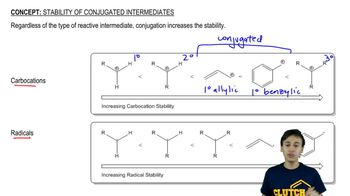
Stability of Conjugated Intermediates

Nucleophilicity and Leaving Group Ability

The outcome of an acyl substitution reaction is significantly affected by the relative strengths of the nucleophile and the leaving group. If the new nucleophile is a stronger base than the existing substituent, it can effectively displace the leaving group, leading to the formation of a new carboxylic acid derivative. Conversely, if the nucleophile is weaker, the reaction may not proceed, resulting in no reaction or the retention of the original acyl compound.
Recommended video:
Guided course
07:22
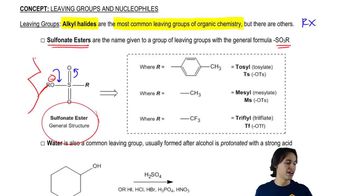
The 3 important leaving groups to know.