b. Explain why the rate of aminolysis of an ester cannot be increased by H+.
Ch. 15 - Reactions of Carboxylic Acids and Carboxylic Acid Derivatives
All textbooks
Bruice 8th Edition
Ch. 15 - Reactions of Carboxylic Acids and Carboxylic Acid Derivatives
Problem 25b
Bruice 8th Edition
Ch. 15 - Reactions of Carboxylic Acids and Carboxylic Acid Derivatives
Problem 25bChapter 16, Problem 25b
What products are obtained from the following reactions? b. phenyl acetate + excess ethanol + HCl
Verified step by step guidance1
Step 1: Recognize the type of reaction. This is an acid-catalyzed esterification (Fischer esterification) or transesterification reaction, where phenyl acetate (an ester) reacts with excess ethanol in the presence of an acid catalyst (HCl).
Step 2: Understand the mechanism. In the presence of HCl, the carbonyl oxygen of the ester (phenyl acetate) gets protonated, making the carbonyl carbon more electrophilic and susceptible to nucleophilic attack by ethanol.
Step 3: Identify the nucleophile and electrophile. Ethanol acts as the nucleophile, attacking the electrophilic carbonyl carbon of phenyl acetate, leading to the formation of a tetrahedral intermediate.
Step 4: Follow the reaction pathway. The tetrahedral intermediate undergoes proton transfers and elimination of the leaving group (phenol, C6H5OH), resulting in the formation of a new ester, ethyl acetate (CH3COOCH2CH3).
Step 5: Summarize the products. The reaction produces ethyl acetate (the new ester) and phenol as the byproduct. The excess ethanol ensures the reaction proceeds to completion by shifting the equilibrium toward product formation.

Verified video answer for a similar problem:
This video solution was recommended by our tutors as helpful for the problem above.
Video duration:
2mWas this helpful?
Key Concepts
Here are the essential concepts you must grasp in order to answer the question correctly.
Ester Hydrolysis
Ester hydrolysis is a reaction where an ester reacts with water or an alcohol in the presence of an acid or base, leading to the formation of an alcohol and a carboxylic acid. In this case, phenyl acetate undergoes hydrolysis in the presence of excess ethanol and HCl, resulting in the formation of phenol and acetic acid.
Recommended video:
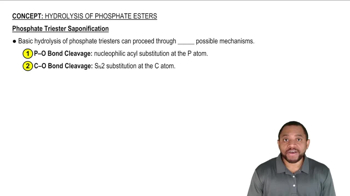
Hydrolysis of Phosphate Esters Concept 2
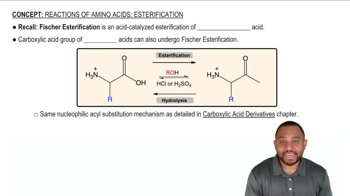
Fischer Esterification
Fischer esterification is a process where a carboxylic acid reacts with an alcohol to form an ester and water, typically catalyzed by an acid. In the context of the given reaction, the excess ethanol can also act as a reactant, potentially leading to the formation of ethyl acetate alongside the hydrolysis products.
Recommended video:
Reactions of Amino Acids: Esterification Concept 1
Role of Catalysts in Reactions
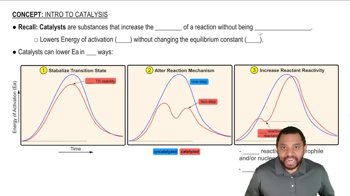
Catalysts, such as HCl in this reaction, are substances that increase the rate of a chemical reaction without being consumed in the process. In ester hydrolysis and Fischer esterification, HCl serves to protonate the carbonyl oxygen of the ester, making it more susceptible to nucleophilic attack by water or ethanol, thus facilitating the reaction.
Recommended video:
Introduction to Catalysis Concept 1
Related Practice
Textbook Question
1248
views
Textbook Question
Using the mechanism for the acid-catalyzed hydrolysis of an ester as your guide, write the mechanism—showing all the curved arrows—for the acid-catalyzed reaction of acetic acid and methanol to form methyl acetate. Use HB+ and :B to represent the proton-donating and proton-removing species, respectively.
1656
views
Textbook Question
Write the mechanism for the acid-catalyzed transesterification of ethyl acetate with methanol.
1295
views
Textbook Question
Write the mechanism for the acid-catalyzed reaction of tert-butyl acetate with methanol.
1263
views
Textbook Question
What products are formed from the acid-catalyzed hydrolysis of the following esters?
a.
b.
1575
views
Textbook Question
Show the mechanism for the acid-catalyzed formation of 23c starting with the product obtained from its hydrolysis.
1018
views