Ch. 15 - Reactions of Carboxylic Acids and Carboxylic Acid Derivatives
Bruice - Organic Chemistry 8th Edition
Bruice8th EditionOrganic ChemistryISBN: 9780135213711Not the one you use?Change textbook
Chapter 16, Problem 4

Which is longer, the carbon–oxygen single bond in a carboxylic acid or the carbon–oxygen bond in an alcohol? Why?

Verified step by step guidance
1
Understand the nature of the bonds: A carbon–oxygen single bond in a carboxylic acid is part of a functional group that includes both a hydroxyl (-OH) group and a carbonyl (C=O) group. In contrast, the carbon–oxygen bond in an alcohol is simply a single bond between a carbon atom and a hydroxyl (-OH) group.
Consider resonance effects: In a carboxylic acid, the carbon–oxygen single bond is influenced by resonance. The lone pairs on the oxygen in the hydroxyl group can delocalize into the carbonyl group, creating partial double-bond character in the carbon–oxygen single bond. This partial double-bond character shortens the bond length compared to a pure single bond.
Analyze the bond in an alcohol: The carbon–oxygen bond in an alcohol does not experience resonance effects. It is a pure single bond, which is typically longer than a bond with partial double-bond character.
Compare bond lengths: Bonds with partial double-bond character, like the carbon–oxygen single bond in a carboxylic acid, are shorter than pure single bonds, such as the carbon–oxygen bond in an alcohol.
Conclude based on bond character: The carbon–oxygen bond in an alcohol is longer than the carbon–oxygen single bond in a carboxylic acid due to the resonance effects in the carboxylic acid that shorten the bond length.

Verified video answer for a similar problem:

This video solution was recommended by our tutors as helpful for the problem above.
Video duration:
4m
Was this helpful?

Key Concepts

Here are the essential concepts you must grasp in order to answer the question correctly.

Bond Length

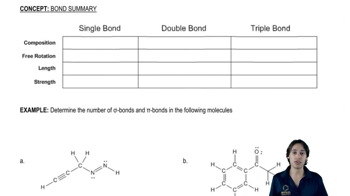
Bond length refers to the distance between the nuclei of two bonded atoms. It is influenced by factors such as atomic size and the type of bond (single, double, or triple). Generally, single bonds are longer than double bonds, and larger atoms tend to form longer bonds due to increased distance between their nuclei.
Recommended video:
Guided course
06:00
Single bonds, double bonds, and triple bonds.

Carboxylic Acids vs. Alcohols

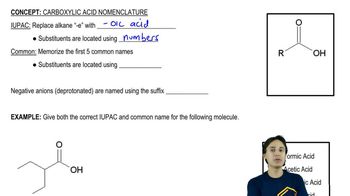
Carboxylic acids contain a carbonyl group (C=O) and a hydroxyl group (–OH) attached to the same carbon atom, while alcohols only have a hydroxyl group attached to a carbon atom. The presence of the carbonyl group in carboxylic acids can affect the bond lengths due to resonance and the overall hybridization of the carbon atom involved.
Recommended video:
Guided course
04:20
Carboxylic Acids Nomenclature

Hybridization

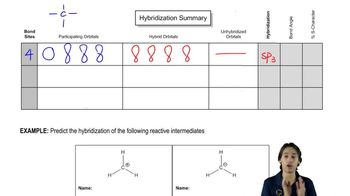
Hybridization is the concept of mixing atomic orbitals to form new hybrid orbitals that can accommodate bonding. In carboxylic acids, the carbon atom is typically sp² hybridized, leading to a different bond character compared to the sp³ hybridized carbon in alcohols. This difference in hybridization can influence the bond lengths of the carbon-oxygen bonds in these compounds.
Recommended video:
Guided course
10:43
Using bond sites to predict hybridization