Ch. 15 - Reactions of Carboxylic Acids and Carboxylic Acid Derivatives
Bruice - Organic Chemistry 8th Edition
Bruice8th EditionOrganic ChemistryISBN: 9780135213711Not the one you use?Change textbook
Chapter 16, Problem 13a

Write the mechanism for each of the following reactions:
a. the reaction of acetyl chloride with water to form acetic acid

Verified step by step guidance
1
Identify the functional groups involved: Acetyl chloride (CH3COCl) is an acid chloride, and water (H2O) is a nucleophile. Acid chlorides are highly reactive due to the electron-withdrawing nature of the chlorine atom, making the carbonyl carbon highly electrophilic.
Step 1: Nucleophilic attack. The lone pair of electrons on the oxygen atom of water attacks the electrophilic carbonyl carbon of acetyl chloride. This forms a tetrahedral intermediate where the carbon is bonded to the original groups (CH3, Cl, and OH2+).
Step 2: Collapse of the tetrahedral intermediate. The negatively charged oxygen from the water attack donates its lone pair back to reform the carbonyl group, causing the chloride ion (Cl⁻) to leave as a leaving group. This step generates acetic acid (CH3COOH) and a chloride ion.
Step 3: Proton transfer. The intermediate acetic acid molecule may initially have an extra proton on the hydroxyl group (OH2+). A proton transfer occurs, either intramolecularly or with the help of another water molecule, to neutralize the charge and form the final acetic acid product.
Review the overall reaction: The reaction converts acetyl chloride (CH3COCl) and water (H2O) into acetic acid (CH3COOH) and hydrochloric acid (HCl). This is a nucleophilic acyl substitution reaction, where the chloride group is replaced by a hydroxyl group.

Verified video answer for a similar problem:

This video solution was recommended by our tutors as helpful for the problem above.
Video duration:
2m
Was this helpful?

Key Concepts

Here are the essential concepts you must grasp in order to answer the question correctly.

Nucleophilic Acyl Substitution

Nucleophilic acyl substitution is a fundamental reaction mechanism in organic chemistry where a nucleophile attacks the carbonyl carbon of an acyl compound, leading to the substitution of the acyl group. In the case of acetyl chloride reacting with water, water acts as the nucleophile, attacking the carbonyl carbon of acetyl chloride, resulting in the formation of acetic acid and hydrochloric acid.
Recommended video:
Guided course
01:47
Nucleophiles and Electrophiles can react in Substitution Reactions.

Acyl Chlorides

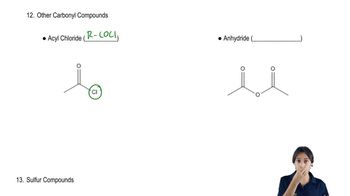
Acyl chlorides, also known as acid chlorides, are reactive compounds derived from carboxylic acids by replacing the hydroxyl group with a chlorine atom. They are highly reactive due to the presence of the electronegative chlorine atom, which makes the carbonyl carbon more susceptible to nucleophilic attack. Understanding their reactivity is crucial for predicting the outcome of reactions involving acyl chlorides.
Recommended video:
Guided course
01:57
Recognizing acyl chlorides and anhydrides.

Hydrolysis Reactions

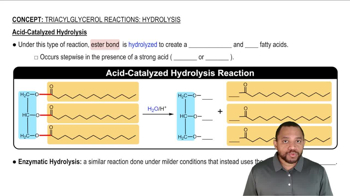
Hydrolysis reactions involve the reaction of a compound with water, leading to the breakdown of that compound. In organic chemistry, hydrolysis is often used to convert acyl chlorides into carboxylic acids. This reaction is typically exothermic and can be catalyzed by the presence of acids or bases, although in this case, water alone suffices to facilitate the conversion of acetyl chloride to acetic acid.
Recommended video:
3:09
Triacylglycerol Reactions: Hydrolysis Concept 3