Ch. 16 - Reactions of Aldehydes and Ketones • More Reactions of Carboxylic Acid Derivatives
Bruice - Organic Chemistry 8th Edition
Bruice8th EditionOrganic ChemistryISBN: 9780135213711Not the one you use?Change textbook
Chapter 17, Problem 64b

Thiols can be prepared from the reaction of thiourea with an alkyl halide, followed by hydroxide-ion-promoted hydrolysis.
b. What thiol will be formed if the alkyl halide employed is pentyl bromide?

Verified step by step guidance
1
Identify the structure of pentyl bromide. Pentyl bromide is an alkyl halide with the molecular formula C5H11Br. It consists of a pentane chain (five carbon atoms in a straight chain) with a bromine atom attached to one of the terminal carbons.
Understand the reaction mechanism. Thiols are typically formed by the nucleophilic substitution (SN2) reaction of an alkyl halide with a sulfide ion (HS⁻). The bromine atom in pentyl bromide will act as a leaving group, and the sulfide ion will replace it.
Write the general reaction. The reaction can be represented as: CH5H11Br + HS-C5H11SH + Br-. Here, the sulfide ion replaces the bromine atom, forming a thiol.
Determine the product. The thiol formed will have the same carbon chain as the starting alkyl halide, but the bromine atom will be replaced by an -SH group. Therefore, the product will be pentanethiol (C5H11SH).
Verify the reaction conditions. Ensure that the reaction is carried out in a suitable solvent (e.g., polar aprotic solvents like DMSO) to favor the SN2 mechanism and avoid side reactions.

Verified video answer for a similar problem:

This video solution was recommended by our tutors as helpful for the problem above.
Video duration:
2m
Was this helpful?

Key Concepts

Here are the essential concepts you must grasp in order to answer the question correctly.

Thiol Formation

Thiol formation involves the nucleophilic substitution reaction where a thiol (R-SH) is produced from an alkyl halide (R-X) and a thiol nucleophile (HS-). In this process, the halide ion (X-) is replaced by the thiol group, resulting in the formation of a new carbon-sulfur bond.
Recommended video:
Guided course
02:26
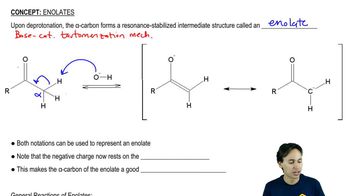
Formation of Enolates

Alkyl Halides

Alkyl halides are organic compounds containing a carbon atom bonded to a halogen atom (such as bromine, chlorine, or iodine). The reactivity of alkyl halides in nucleophilic substitution reactions is influenced by the structure of the alkyl group and the nature of the halogen, with primary alkyl halides like pentyl bromide being more reactive than secondary or tertiary ones.
Recommended video:
Guided course
01:52
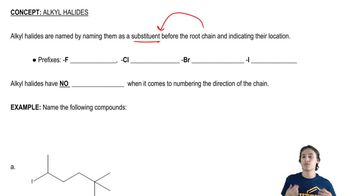
How to name alkyl halides

Nucleophilic Substitution Mechanisms

Nucleophilic substitution can occur via two main mechanisms: SN1 and SN2. The SN2 mechanism is a one-step process where the nucleophile attacks the carbon atom from the opposite side of the leaving group, leading to inversion of configuration. In contrast, the SN1 mechanism involves a two-step process where the leaving group departs first, forming a carbocation intermediate, followed by nucleophilic attack.
Recommended video:
Guided course
01:47
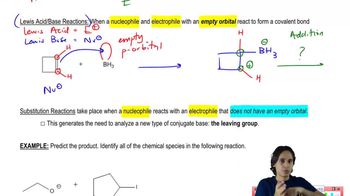
Nucleophiles and Electrophiles can react in Substitution Reactions.