Ch. 16 - Reactions of Aldehydes and Ketones • More Reactions of Carboxylic Acid Derivatives
Bruice - Organic Chemistry 8th Edition
Bruice8th EditionOrganic ChemistryISBN: 9780135213711Not the one you use?Change textbook
Chapter 17, Problem 56

Draw the structure of two esters that will be reduced to propanol and butanol by LiAlH4 (followed by addition of aqueous acid).

Verified step by step guidance
1
Identify the general reaction mechanism: Lithium aluminum hydride (LiAlH4) is a strong reducing agent that reduces esters to their corresponding primary alcohols. The reaction involves breaking the ester bond and converting the carbonyl group into a hydroxyl group.
Determine the alcohol products: The problem specifies that the reduction yields propanol (C3H8O) and butanol (C4H10O). This means the esters must contain the corresponding alkyl groups that will form these alcohols upon reduction.
Write the general structure of an ester: Esters have the general formula RCOOR', where R is the alkyl group attached to the carbonyl carbon, and R' is the alkyl group attached to the oxygen atom. The reduction will break the bond between the carbonyl carbon and the oxygen atom of the ester group.
Assign the appropriate alkyl groups: To form propanol, one ester should have a propyl group (C3H7) as R'. To form butanol, the other ester should have a butyl group (C4H9) as R'. The R group in each ester can be any alkyl group, as it will not affect the alcohol product.
Draw the structures of the esters: For the ester that reduces to propanol, an example structure is ethyl propanoate (CH3CH2COOCH2CH3). For the ester that reduces to butanol, an example structure is methyl butanoate (CH3CH2CH2COOCH3). These esters will yield the desired alcohols upon reduction with LiAlH4 followed by aqueous acid.

Verified video answer for a similar problem:

This video solution was recommended by our tutors as helpful for the problem above.
Video duration:
4m
Was this helpful?

Key Concepts

Here are the essential concepts you must grasp in order to answer the question correctly.

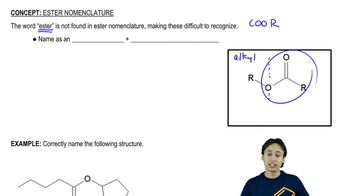
Esters

Esters are organic compounds formed from the reaction of an alcohol and a carboxylic acid, characterized by the functional group -COO-. They are often used in the production of fragrances and flavorings. Understanding the structure of esters is crucial for predicting their reactivity, particularly in reduction reactions.
Recommended video:
Guided course
02:39
Ester Nomenclature

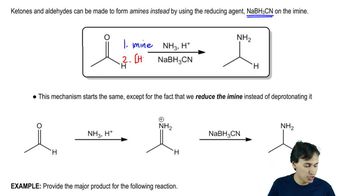
Reduction with LiAlH4

Lithium aluminum hydride (LiAlH4) is a strong reducing agent commonly used in organic chemistry to reduce esters to alcohols. The reduction process involves the addition of hydride ions to the carbonyl carbon of the ester, leading to the formation of an intermediate that eventually yields an alcohol upon hydrolysis. This reaction is essential for converting esters into primary alcohols.
Recommended video:
Guided course
07:12
Reductive Amination

Propanol and Butanol

Propanol and butanol are primary alcohols derived from the reduction of specific esters. Propanol (C3H8O) can be obtained from the reduction of propanoate esters, while butanol (C4H10O) comes from butanoate esters. Recognizing the relationship between the structure of the starting ester and the resulting alcohol is key to solving the question.
Recommended video:
Guided course
01:40
Same atoms, same connectivity, 1 chiral center.