Ch. 16 - Reactions of Aldehydes and Ketones • More Reactions of Carboxylic Acid Derivatives
Bruice - Organic Chemistry 8th Edition
Bruice8th EditionOrganic ChemistryISBN: 9780135213711Not the one you use?Change textbook
Chapter 17, Problem 72b

How could you convert N-methylbenzamide to the following compounds?
b. benzoic acid

Verified step by step guidance
1
Step 1: Identify the functional groups in N-methylbenzamide. It contains an amide group (-CONH-) attached to a benzene ring and a methyl group attached to the nitrogen atom.
Step 2: To convert N-methylbenzamide to benzoic acid, the amide group needs to be hydrolyzed. Hydrolysis of amides typically involves breaking the C-N bond and replacing the nitrogen with a hydroxyl group (-OH).
Step 3: Use acidic or basic hydrolysis conditions. Acidic hydrolysis involves heating the amide with a strong acid like HCl or H2SO4 in water, while basic hydrolysis involves heating with a strong base like NaOH or KOH in water.
Step 4: During hydrolysis, the methyl group attached to the nitrogen will be removed, and the benzamide will be converted into benzoic acid (C6H5COOH).
Step 5: After the reaction, isolate and purify the benzoic acid product using techniques such as recrystallization or extraction.

Verified video answer for a similar problem:

This video solution was recommended by our tutors as helpful for the problem above.
Video duration:
2m
Was this helpful?

Key Concepts

Here are the essential concepts you must grasp in order to answer the question correctly.

Amide Hydrolysis

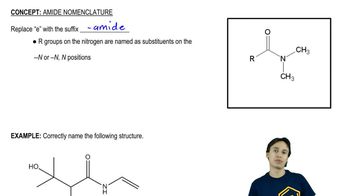
Amide hydrolysis is a chemical reaction where an amide is converted into a carboxylic acid and an amine or ammonia, typically in the presence of water and an acid or base. In this case, N-methylbenzamide undergoes hydrolysis to yield benzoic acid and methylamine. Acid-catalyzed hydrolysis is common in organic chemistry, facilitating the breakdown of amides under mild conditions.
Recommended video:
Guided course
01:33
Amide Nomenclature

Ester Hydrolysis

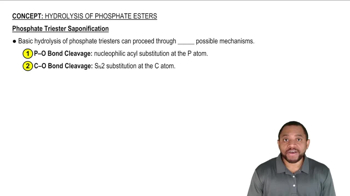
Ester hydrolysis is the process of breaking down an ester into its constituent alcohol and carboxylic acid through the addition of water. This reaction can be catalyzed by acids or bases. In the context of converting N-methylbenzamide to benzoic acid, understanding ester hydrolysis is crucial, as the reaction mechanism may involve the formation of an intermediate ester before yielding the final products.
Recommended video:
0:48
Hydrolysis of Phosphate Esters Concept 2

Acid-Base Catalysis

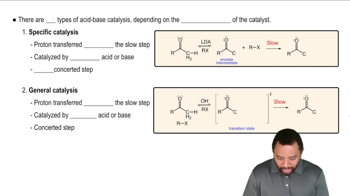
Acid-base catalysis involves the use of an acid or base to accelerate a chemical reaction. In the hydrolysis of amides, an acid catalyst can protonate the carbonyl oxygen, increasing the electrophilicity of the carbonyl carbon and facilitating nucleophilic attack by water. This concept is essential for understanding how the reaction proceeds more efficiently and the role of catalysts in organic transformations.
Recommended video:
2:50
Acid-Base Catalysis Concept 3