Ch. 16 - Reactions of Aldehydes and Ketones • More Reactions of Carboxylic Acid Derivatives
Bruice - Organic Chemistry 8th Edition
Bruice8th EditionOrganic ChemistryISBN: 9780135213711Not the one you use?Change textbook
Chapter 17, Problem 69

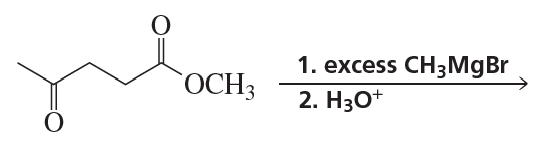
How many signals would the product of the following reaction show in
a. its 1H NMR spectrum?
b. its 13C NMR spectrum?
Chemical reaction diagram showing a compound with labels for reagents and steps for NMR analysis.

Verified step by step guidance
1
Analyze the reaction to determine the structure of the product. Identify the functional groups and symmetry elements in the molecule, as these will influence the number of unique environments for both hydrogen and carbon atoms.
For the 1H NMR spectrum: Identify all unique hydrogen environments in the product. Hydrogens in the same chemical environment (e.g., due to symmetry or identical surroundings) will produce the same signal. Consider factors like equivalent hydrogens on methyl groups, aromatic rings, or aliphatic chains.
For the 13C NMR spectrum: Identify all unique carbon environments in the product. Carbons in the same chemical environment will produce the same signal. Consider symmetry and the types of carbons present (e.g., sp3, sp2, or sp carbons, as well as carbons in identical functional groups).
Count the number of unique hydrogen environments to determine the number of signals in the 1H NMR spectrum. Ensure you account for any splitting patterns caused by neighboring hydrogens, though splitting does not affect the number of signals.
Count the number of unique carbon environments to determine the number of signals in the 13C NMR spectrum. Symmetry plays a significant role here, so ensure you carefully evaluate the molecule's structure for equivalent carbons.

Verified video answer for a similar problem:

This video solution was recommended by our tutors as helpful for the problem above.
Was this helpful?

Key Concepts

Here are the essential concepts you must grasp in order to answer the question correctly.

Nuclear Magnetic Resonance (NMR) Spectroscopy

NMR spectroscopy is a powerful analytical technique used to determine the structure of organic compounds. It relies on the magnetic properties of certain nuclei, primarily hydrogen (1H) and carbon (13C), to provide information about the number of unique environments in a molecule. The resulting spectra reveal signals corresponding to these environments, which can be interpreted to deduce molecular structure.
Recommended video:
Guided course
10:06
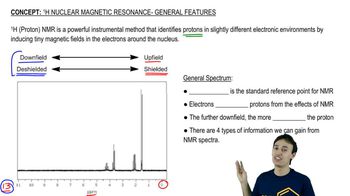
General NMR Features

Chemical Environment

The chemical environment refers to the specific surroundings of a nucleus within a molecule, which influences its magnetic resonance signal. Factors such as electronegativity of nearby atoms, hybridization, and molecular symmetry affect the chemical shift observed in NMR spectra. Identifying unique chemical environments is crucial for determining the number of signals in both 1H and 13C NMR spectra.
Recommended video:
3:11
Chemical Reactions of Phosphate Anhydrides Concept 1

Multiplicity and Integration

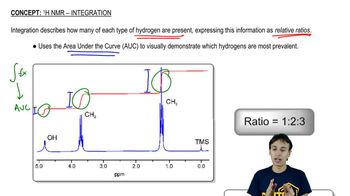
Multiplicity in NMR refers to the splitting of signals due to spin-spin coupling between neighboring nuclei, while integration indicates the relative number of protons contributing to a signal. Understanding these concepts helps in interpreting the complexity of the NMR spectrum, allowing chemists to deduce not only the number of signals but also the relationships between different hydrogen or carbon environments in the molecule.
Recommended video:
Guided course
06:46
1H NMR Integration