Ch. 16 - Reactions of Aldehydes and Ketones • More Reactions of Carboxylic Acid Derivatives
Bruice - Organic Chemistry 8th Edition
Bruice8th EditionOrganic ChemistryISBN: 9780135213711Not the one you use?Change textbook
Chapter 17, Problem 23c

How would you make the following compounds from N-benzylbenzamide?
c. benzyl alcohol

Verified step by step guidance
1
Step 1: Analyze the starting material, N-benzylbenzamide. It contains an amide functional group (-CONH-) attached to a benzyl group and a benzene ring. The target compound, benzyl alcohol, has a hydroxyl (-OH) group attached to the benzyl group.
Step 2: Recognize that the transformation involves breaking the amide bond and reducing the benzyl group to form benzyl alcohol. This requires cleaving the bond between the carbonyl carbon and the nitrogen atom.
Step 3: Use hydrolysis to break the amide bond. Acidic or basic hydrolysis can be employed to convert the amide into a carboxylic acid and a free amine. For example, using HCl or NaOH under heat will yield benzoic acid and benzylamine.
Step 4: Reduce the benzylamine to benzyl alcohol. This can be achieved using a reducing agent such as sodium borohydride (NaBH4) or lithium aluminum hydride (LiAlH4), which will convert the amine group (-NH2) to a hydroxyl group (-OH).
Step 5: Purify the benzyl alcohol product using techniques such as distillation or recrystallization, depending on the reaction conditions and the presence of impurities.

Verified video answer for a similar problem:

This video solution was recommended by our tutors as helpful for the problem above.
Video duration:
4m
Was this helpful?

Key Concepts

Here are the essential concepts you must grasp in order to answer the question correctly.

N-benzylbenzamide Structure

N-benzylbenzamide is an amide compound where a benzyl group is attached to the nitrogen of a benzamide. Understanding its structure is crucial for recognizing how it can be transformed into other compounds, such as benzyl alcohol. The presence of the amide functional group influences the reactivity and the types of reactions that can be performed on this molecule.
Recommended video:
1:48
Synthesis of Amino Acids: N-Phthalimidomalonic Ester Synthesis Example 1

Reduction Reactions

Reduction reactions involve the gain of electrons or the decrease in oxidation state of a molecule. In the context of converting N-benzylbenzamide to benzyl alcohol, a common method is the reduction of the amide group. This process typically requires a reducing agent, such as lithium aluminum hydride (LiAlH4), which effectively converts the carbonyl group of the amide to an alcohol.
Recommended video:
Guided course
07:12
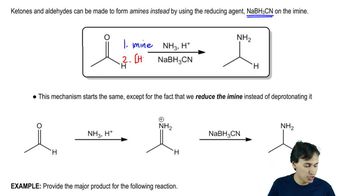
Reductive Amination

Functional Group Transformation

Functional group transformation refers to the process of converting one functional group into another through chemical reactions. In this case, the transformation of the amide functional group in N-benzylbenzamide to the alcohol functional group in benzyl alcohol is a key step. Understanding how to manipulate functional groups is essential for synthesizing desired organic compounds.
Recommended video:
Guided course
02:36
Identifying Functional Groups