Ch. 16 - Reactions of Aldehydes and Ketones • More Reactions of Carboxylic Acid Derivatives
Bruice - Organic Chemistry 8th Edition
Bruice8th EditionOrganic ChemistryISBN: 9780135213711Not the one you use?Change textbook
Chapter 17, Problem 31

Imines can exist as stereoisomers. The isomers are named using the E,Z system of nomenclature (Section 4.2 ). The lone pair has the lowest priority.
<IMAGE>
Draw the structure of each of the following compounds:
a. the (E)-hydrazone of benzaldehyde
b. the (Z)-oxime of propiophenone

Verified step by step guidance
1
Step 1: Understand the E,Z nomenclature system. In this system, the priority of substituents around a double bond is determined using the Cahn-Ingold-Prelog rules. The (E)-isomer has the higher priority groups on opposite sides of the double bond, while the (Z)-isomer has them on the same side.
Step 2: For part (a), the (E)-hydrazone of benzaldehyde, start by identifying the structure of benzaldehyde (C6H5CHO). Replace the oxygen in the aldehyde group with a hydrazone group (-NH-NH2). Then, arrange the substituents such that the higher priority groups (phenyl group and hydrazone group) are on opposite sides of the C=N double bond.
Step 3: For part (b), the (Z)-oxime of propiophenone, begin by identifying the structure of propiophenone (C6H5-CO-CH3). Replace the oxygen in the ketone group with an oxime group (-C=N-OH). Arrange the substituents such that the higher priority groups (phenyl group and oxime group) are on the same side of the C=N double bond.
Step 4: Use the lone pair on the nitrogen atom to determine the lowest priority group in both cases. Ensure that the lone pair is correctly positioned according to the E,Z configuration rules.
Step 5: Draw the final structures for both compounds, ensuring that the stereochemistry matches the (E) and (Z) configurations as described. Verify the placement of substituents and lone pairs to confirm the correct stereoisomer.

Verified video answer for a similar problem:

This video solution was recommended by our tutors as helpful for the problem above.
Video duration:
3m
Was this helpful?

Key Concepts

Here are the essential concepts you must grasp in order to answer the question correctly.

E/Z Nomenclature

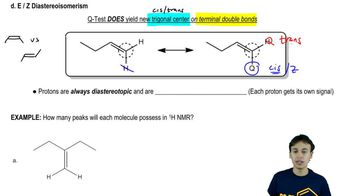
The E/Z system is a method for describing the stereochemistry of alkenes and imines based on the Cahn-Ingold-Prelog priority rules. In this system, 'E' (from the German 'entgegen') indicates that the highest priority substituents on either side of a double bond are on opposite sides, while 'Z' (from 'zusammen') indicates they are on the same side. This nomenclature is crucial for distinguishing between different stereoisomers.
Recommended video:
Guided course
03:48
E/Z Diastereoisomerism

Imines

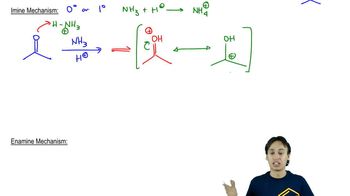
Imines are organic compounds characterized by a carbon-nitrogen double bond (C=N), where the nitrogen atom is typically bonded to a hydrogen atom or an organic group. They are formed through the condensation of an amine and a carbonyl compound, such as an aldehyde or ketone. Imines can exhibit stereoisomerism due to the presence of the double bond, allowing for E/Z configurations.
Recommended video:
Guided course
06:23
Imine Mechanism

Hydrazones and Oximes

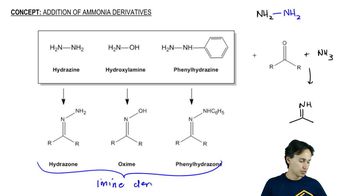
Hydrazones and oximes are specific types of imines formed from hydrazines and hydroxylamines, respectively. A hydrazone is formed when a hydrazine reacts with a carbonyl compound, while an oxime is produced when a hydroxylamine reacts with a carbonyl compound. Both types of compounds can also exhibit E/Z stereoisomerism, depending on the arrangement of substituents around the C=N bond.
Recommended video:
Guided course
02:49
Ammonia Derivatives