Ch. 16 - Reactions of Aldehydes and Ketones • More Reactions of Carboxylic Acid Derivatives
Bruice - Organic Chemistry 8th Edition
Bruice8th EditionOrganic ChemistryISBN: 9780135213711Not the one you use?Change textbook
Chapter 17, Problem 46a

Show how each of the following compounds could be prepared from the given starting material. Each requires a protecting group.
a.

Verified step by step guidance
1
Step 1: Identify the functional groups in the starting material and the target compound. The starting material contains a bromine atom and a hydroxyl group (-OH), while the target compound has two hydroxyl groups (-OH). This suggests that the bromine atom needs to be replaced with a hydroxyl group.
Step 2: Recognize the need for a protecting group. The hydroxyl group in the starting material must be protected to prevent unwanted reactions during the substitution of bromine with a hydroxyl group.
Step 3: Protect the hydroxyl group using a suitable protecting group, such as a silyl ether (e.g., TBDMS-Cl or TMS-Cl). This step involves reacting the starting material with the protecting agent in the presence of a base like imidazole.
Step 4: Perform the substitution reaction to replace the bromine atom with a hydroxyl group. This can be achieved using a nucleophilic substitution reaction, such as hydrolysis with aqueous NaOH or KOH.
Step 5: Remove the protecting group to regenerate the original hydroxyl group. This can be done using a deprotection reagent, such as TBAF (tetrabutylammonium fluoride), to yield the final target compound with two hydroxyl groups.

Verified video answer for a similar problem:

This video solution was recommended by our tutors as helpful for the problem above.
Video duration:
10m
Was this helpful?

Key Concepts

Here are the essential concepts you must grasp in order to answer the question correctly.

Protecting Groups

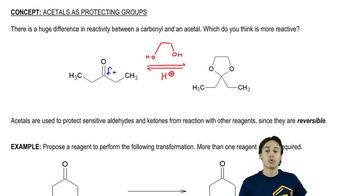
Protecting groups are temporary modifications used in organic synthesis to prevent certain functional groups from reacting during a chemical reaction. They allow for selective reactions to occur on other parts of the molecule without interference. After the desired reactions are completed, the protecting group can be removed to restore the original functional group.
Recommended video:
Guided course
02:44
Protecting Groups

Nucleophilic Substitution Reactions

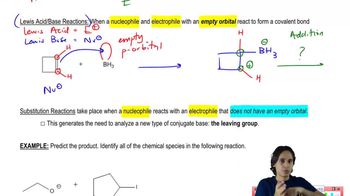
Nucleophilic substitution reactions involve the replacement of a leaving group (like bromine) by a nucleophile (such as an alcohol or an alkoxide). This type of reaction is fundamental in organic chemistry for forming new bonds and modifying molecular structures. The mechanism can proceed via either an SN1 or SN2 pathway, depending on the substrate and conditions.
Recommended video:
Guided course
01:47
Nucleophiles and Electrophiles can react in Substitution Reactions.

Stereochemistry

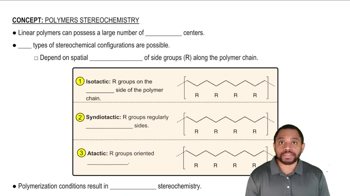
Stereochemistry is the study of the spatial arrangement of atoms in molecules and how this affects their chemical behavior. In the context of organic reactions, understanding stereochemistry is crucial for predicting the outcomes of reactions, especially when chiral centers are involved. The configuration of the product can influence its reactivity and interactions in biological systems.
Recommended video:
1:38
Polymer Stereochemistry Concept 1