Ch. 16 - Reactions of Aldehydes and Ketones • More Reactions of Carboxylic Acid Derivatives
Bruice - Organic Chemistry 8th Edition
Bruice8th EditionOrganic ChemistryISBN: 9780135213711Not the one you use?Change textbook
Chapter 17, Problem 11

Which of the following compounds does not form an alcohol when it reacts with excess Grignard reagent?
Structures of three compounds labeled A, B, and C, questioning which does not form an alcohol with Grignard reagent.

Verified step by step guidance
1
Identify the functional groups in each compound. For compound A, CH3CH2(C=O)NHCH3, the functional group is an amide (C=O attached to NH). For compound B, CH3CH2(C=O)OCH3, the functional group is an ester (C=O attached to OCH3). For compound C, HOCH2CH2(C=O)OCH3, the functional groups are an ester (C=O attached to OCH3) and an alcohol (OH).
Recall the reactivity of Grignard reagents. Grignard reagents (RMgX) are nucleophiles that react with electrophilic carbonyl groups (C=O) to form alcohols. However, certain functional groups, such as amides, do not react with Grignard reagents because the lone pair on the nitrogen delocalizes into the carbonyl group, reducing its electrophilicity.
Analyze compound A (amide). The carbonyl group in the amide is not electrophilic enough to react with a Grignard reagent due to resonance stabilization. Therefore, compound A will not form an alcohol when reacted with excess Grignard reagent.
Analyze compound B (ester). Esters react with excess Grignard reagent in a two-step process: the first equivalent of Grignard reagent forms a ketone intermediate, and the second equivalent reacts with the ketone to form a tertiary alcohol. Thus, compound B will form an alcohol.
Analyze compound C (ester and alcohol). The ester group in compound C will react with excess Grignard reagent in the same manner as compound B, forming an alcohol. The hydroxyl group (OH) in compound C does not interfere with this reaction. Therefore, compound C will also form an alcohol.

Verified video answer for a similar problem:

This video solution was recommended by our tutors as helpful for the problem above.
Video duration:
3m
Was this helpful?

Key Concepts

Here are the essential concepts you must grasp in order to answer the question correctly.

Grignard Reagents

Grignard reagents are organomagnesium compounds that are highly reactive and used in organic synthesis to form carbon-carbon bonds. They react with electrophiles, such as carbonyl compounds, to produce alcohols. Understanding their reactivity is crucial for predicting the products of reactions involving these reagents.
Recommended video:
Guided course
02:12
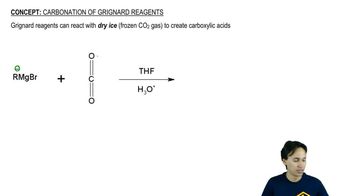
Carbonation of Grignard Reagents

Carbonyl Compounds

Carbonyl compounds contain a carbon atom double-bonded to an oxygen atom (C=O). They are key electrophiles in organic chemistry and can react with Grignard reagents to form alcohols. The nature of the carbonyl compound (e.g., aldehyde, ketone, or ester) influences the outcome of the reaction with Grignard reagents.
Recommended video:
Guided course
01:40
Defining meso compounds.

Alcohol Formation

Alcohols are organic compounds characterized by the presence of one or more hydroxyl (-OH) groups. When Grignard reagents react with carbonyl compounds, they typically lead to the formation of alcohols. However, certain functional groups, such as amides or esters, may not yield alcohols upon reaction, which is essential to consider in this question.
Recommended video:
Guided course
01:01
How to name alcohols