Ch. 17 - Reactions at the Alpha-Carbon
Bruice - Organic Chemistry 8th Edition
Bruice8th EditionOrganic ChemistryISBN: 9780135213711Not the one you use?Change textbook
Chapter 18, Problem 3

Explain why a base can remove a proton from the α-carbon of N,N-dimethylethanamide but not from the α-carbon of either N-methylethanamide or ethanamide.

Verified step by step guidance
1
Step 1: Analyze the structures of the three compounds provided in the image. N,N-dimethylethanamide has two methyl groups attached to the nitrogen atom, N-methylethanamide has one methyl group attached to the nitrogen atom, and ethanamide has no methyl groups attached to the nitrogen atom.
Step 2: Understand the concept of resonance stabilization. In amides, the lone pair of electrons on the nitrogen can delocalize into the carbonyl group, creating resonance structures. This delocalization reduces the availability of the nitrogen's lone pair for other interactions, such as stabilizing a negative charge on the α-carbon.
Step 3: Consider the steric and electronic effects of the substituents on the nitrogen. In N,N-dimethylethanamide, the two methyl groups reduce the ability of the nitrogen to participate in resonance with the carbonyl group due to steric hindrance and electronic effects. This makes the α-carbon more acidic, allowing a base to remove a proton.
Step 4: Compare this to N-methylethanamide and ethanamide. In these compounds, the nitrogen is less sterically hindered and can more effectively delocalize its lone pair into the carbonyl group. This resonance stabilization reduces the acidity of the α-carbon, making it less likely for a base to remove a proton.
Step 5: Conclude that the increased steric hindrance and reduced resonance stabilization in N,N-dimethylethanamide make the α-carbon more acidic, allowing a base to remove a proton. In contrast, the α-carbon in N-methylethanamide and ethanamide is less acidic due to greater resonance stabilization.

Verified video answer for a similar problem:

This video solution was recommended by our tutors as helpful for the problem above.
Video duration:
1m
Was this helpful?

Key Concepts

Here are the essential concepts you must grasp in order to answer the question correctly.

Acidity and Basicity

Acidity refers to the ability of a compound to donate protons (H+), while basicity is the ability to accept protons. The strength of an acid or base is influenced by the stability of the resulting conjugate base or acid. In the context of amides, the presence of electron-donating groups can stabilize the negative charge on the conjugate base, affecting the acidity of the hydrogen atoms on the alpha-carbon.
Recommended video:
Guided course
06:21
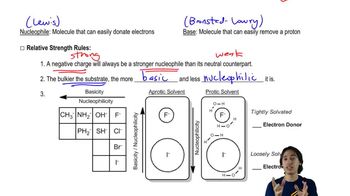
Understanding the difference between basicity and nucleophilicity.

Steric Hindrance

Steric hindrance occurs when the spatial arrangement of atoms in a molecule prevents certain reactions from occurring. In N,N-dimethylethanamide, the two methyl groups create a sterically hindered environment that allows for easier deprotonation at the alpha-carbon. In contrast, N-methylethanamide and ethanamide have less steric hindrance, making it more difficult for a base to access and remove the proton from the alpha-carbon.
Recommended video:
Guided course
02:53
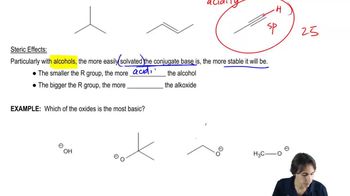
Understanding steric effects.

Resonance Stabilization

Resonance stabilization refers to the delocalization of electrons across multiple atoms, which can stabilize charged species. In N,N-dimethylethanamide, the resonance structures can help stabilize the negative charge formed after deprotonation at the alpha-carbon. This stabilization is less effective in N-methylethanamide and ethanamide, where the resonance structures do not provide the same level of support for the resulting conjugate base.
Recommended video:
Guided course
03:43
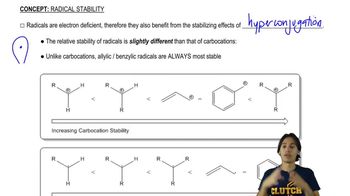
The radical stability trend.