Ch. 17 - Reactions at the Alpha-Carbon
Bruice - Organic Chemistry 8th Edition
Bruice8th EditionOrganic ChemistryISBN: 9780135213711Not the one you use?Change textbook
Chapter 18, Problem 59a,b,c

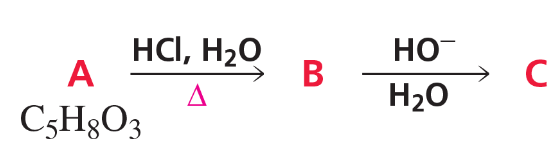
Identify A–C. (Hint: A shows three singlets in its 1H NMR spectrum with integral ratios 3 : 2 : 3 and gives a positive iodoform test; see Problem 58.)
Chemical reaction diagram showing compounds A, B, and C with structural formulas and reaction conditions labeled.

Verified step by step guidance
1
Step 1: Analyze the given hint and the reaction sequence. The hint mentions that compound A shows three singlets in its 1H NMR spectrum with integral ratios 3:2:3 and gives a positive iodoform test. A positive iodoform test indicates the presence of a methyl ketone group (CH3-C=O). The NMR data suggests three distinct environments for protons, likely corresponding to methyl groups, a CH2 group, and another methyl group.
Step 2: Examine the reaction sequence. Compound I (C11H20O3) undergoes hydrolysis in acidic conditions (HCl, H2O, Δ) to form compound II. Acidic hydrolysis typically breaks ester bonds, forming carboxylic acids or alcohols. Compound II then undergoes hydrolysis in basic conditions (HO-, H2O), which could further cleave ester or amide bonds.
Step 3: Compound III is formed after the basic hydrolysis of II. Compound III is then subjected to acidic conditions (HCl, Δ), which may lead to decarboxylation or further hydrolysis. This sequence suggests that the reactions are progressively simplifying the structure, possibly leading to smaller molecules.
Step 4: Based on the hint and the reaction sequence, compound A (likely derived from III or IV) must contain a methyl ketone group to give a positive iodoform test. The NMR data (3:2:3 singlets) suggests a symmetrical structure with distinct proton environments. Consider the possibility of acetone or a similar compound as A.
Step 5: To identify compounds B and C, trace the intermediates formed during the reaction sequence. Compound B is likely the product of the first hydrolysis step, and compound C is the product of the second hydrolysis step. Use the molecular formula and reaction conditions to deduce their structures, keeping in mind the functional groups involved (esters, carboxylic acids, alcohols, etc.).

Verified video answer for a similar problem:

This video solution was recommended by our tutors as helpful for the problem above.
Video duration:
8m
Was this helpful?

Key Concepts

Here are the essential concepts you must grasp in order to answer the question correctly.

NMR Spectroscopy

Nuclear Magnetic Resonance (NMR) spectroscopy is a powerful analytical technique used to determine the structure of organic compounds. It provides information about the number of hydrogen atoms in different environments, represented by peaks in the spectrum. The integral ratios of these peaks indicate the relative number of protons contributing to each signal, which is crucial for identifying molecular structure.
Recommended video:
Guided course
10:06
General NMR Features

Iodoform Test

The iodoform test is a qualitative reaction used to identify methyl ketones and certain alcohols. When a compound containing a methyl group adjacent to a carbonyl group is treated with iodine and a base, it produces a yellow precipitate of iodoform (CHI3). A positive result indicates the presence of a specific structural feature, aiding in the identification of the compound in question.
Recommended video:
Guided course
11:40
Q-Test (Proton Relationships)

Aldol Condensation

Aldol condensation is a fundamental reaction in organic chemistry where aldehydes or ketones with alpha-hydrogens react in the presence of a base to form beta-hydroxy aldehydes or ketones. This reaction can further dehydrate to yield α,β-unsaturated carbonyl compounds. Understanding this mechanism is essential for analyzing reaction pathways and predicting the products of complex organic transformations.
Recommended video:
Guided course
09:51
Crossed Aldol