Ch. 17 - Reactions at the Alpha-Carbon
Bruice - Organic Chemistry 8th Edition
Bruice8th EditionOrganic ChemistryISBN: 9780135213711Not the one you use?Change textbook
Chapter 18, Problem 51

The 1H NMR chemical shifts of nitromethane, dinitromethane, and trinitromethane are at δ6.10, δ4.33, and δ7.52. Match each chemical shift with the compound. Explain how chemical shift correlates with pKa.

Verified step by step guidance
1
Understand the relationship between chemical shift and electron density: In 1H NMR spectroscopy, the chemical shift is influenced by the electron density around the hydrogen atoms. A higher electron density results in shielding, leading to a lower chemical shift (downfield), while a lower electron density results in deshielding, leading to a higher chemical shift (upfield).
Analyze the compounds: Nitromethane (CH3NO2), dinitromethane (CH2(NO2)2), and trinitromethane (CH(NO2)3) have progressively more electron-withdrawing nitro (-NO2) groups attached to the central carbon. Nitro groups are highly electronegative and withdraw electron density from the hydrogen atoms, causing deshielding and increasing the chemical shift.
Match the chemical shifts: The compound with the highest number of nitro groups (trinitromethane) will have the most deshielded hydrogens and the highest chemical shift (δ 7.52). The compound with the fewest nitro groups (nitromethane) will have the least deshielded hydrogens and the lowest chemical shift (δ 6.10). Dinitromethane, with an intermediate number of nitro groups, will have a chemical shift between the two (δ 4.33).
Correlate chemical shift with pKa: The pKa of a compound is influenced by the electron-withdrawing ability of substituents. More nitro groups increase the acidity of the compound (lower pKa) by stabilizing the conjugate base through resonance and inductive effects. Thus, trinitromethane has the lowest pKa, followed by dinitromethane, and then nitromethane. This trend aligns with the chemical shift values, as more acidic compounds tend to have more deshielded hydrogens.
Summarize the matching: Based on the analysis, nitromethane corresponds to δ 6.10, dinitromethane corresponds to δ 4.33, and trinitromethane corresponds to δ 7.52. The chemical shift values reflect the increasing deshielding effect of the nitro groups and correlate with the decreasing pKa values of the compounds.

Verified video answer for a similar problem:

This video solution was recommended by our tutors as helpful for the problem above.
Video duration:
6m
Was this helpful?

Key Concepts

Here are the essential concepts you must grasp in order to answer the question correctly.

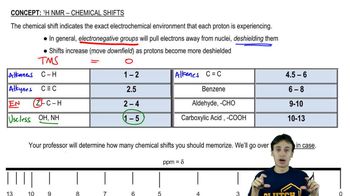
Chemical Shift in NMR Spectroscopy

Chemical shift is a key parameter in nuclear magnetic resonance (NMR) spectroscopy that indicates the resonance frequency of a nucleus relative to a standard reference. It is measured in parts per million (ppm) and reflects the electronic environment surrounding the nucleus. Different functional groups and substituents can cause variations in chemical shifts, allowing chemists to deduce structural information about the compound.
Recommended video:
Guided course
11:44
1H NMR Chemical Shifts

pKa and Acidity

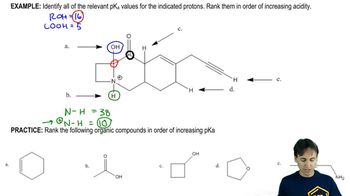
pKa is a measure of the acidity of a compound, representing the negative logarithm of the acid dissociation constant (Ka). A lower pKa value indicates a stronger acid, meaning it more readily donates protons (H+). The relationship between pKa and chemical shift arises because electron-withdrawing groups, such as nitro groups, can stabilize the negative charge of the conjugate base, influencing the chemical environment and thus the NMR chemical shifts.
Recommended video:
Guided course
07:45
Identifying pKa values

Electron-Withdrawing Effects

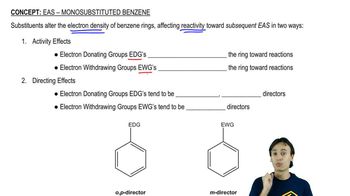
Electron-withdrawing groups (EWGs) are substituents that pull electron density away from the rest of the molecule, often through inductive or resonance effects. In the context of nitromethane and its derivatives, the presence of nitro groups significantly affects the electron density around the hydrogen atoms, leading to shifts in their NMR signals. This alteration in electron density correlates with changes in acidity, as stronger EWGs typically increase acidity by stabilizing the conjugate base.
Recommended video:
Guided course
04:29
Activity and Directing Effects