Ch. 17 - Reactions at the Alpha-Carbon
Bruice - Organic Chemistry 8th Edition
Bruice8th EditionOrganic ChemistryISBN: 9780135213711Not the one you use?Change textbook
Chapter 18, Problem 65b

There are other condensation reactions similar to the aldol and Claisen condensations:

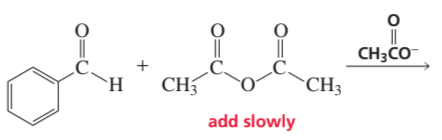
b. What compound is formed if water is added to the product of a Perkin condensation?

Verified step by step guidance
1
Step 1: Understand the Perkin condensation reaction. It involves the reaction of an aromatic aldehyde with an anhydride in the presence of a base to form an α,β-unsaturated carboxylic acid derivative.
Step 2: Analyze the product of the Perkin condensation shown in the image. The product is an α,β-unsaturated carboxylic acid derivative with a conjugated double bond system.
Step 3: Consider the addition of water to the product. Water can hydrolyze the double bond in the α,β-unsaturated system under certain conditions, leading to hydration at the β-carbon.
Step 4: The hydration reaction typically forms a β-hydroxy carboxylic acid. This occurs because water adds across the double bond, with the hydroxyl group attaching to the β-carbon and the hydrogen attaching to the α-carbon.
Step 5: The final compound formed after water addition is a β-hydroxy derivative of the original α,β-unsaturated carboxylic acid. This transformation is a key step in understanding the reactivity of α,β-unsaturated systems in organic chemistry.

Verified video answer for a similar problem:

This video solution was recommended by our tutors as helpful for the problem above.
Video duration:
1m
Was this helpful?

Key Concepts

Here are the essential concepts you must grasp in order to answer the question correctly.

Perkin Condensation

The Perkin condensation is a reaction between an aromatic aldehyde and an anhydride, typically yielding α,β-unsaturated carboxylic acids. This reaction involves the formation of a carbon-carbon bond through the nucleophilic attack of the enolate ion derived from the anhydride on the carbonyl carbon of the aldehyde, followed by dehydration to form the final product.
Recommended video:
Guided course
05:53
Condensation Reactions

Hydrolysis

Hydrolysis is a chemical reaction involving the breaking of a bond in a molecule using water. In the context of the Perkin condensation product, adding water can lead to the conversion of the α,β-unsaturated carboxylic acid into its corresponding carboxylic acid and alcohol, effectively reversing the condensation process and yielding more stable products.
Recommended video:
1:00
Hydrolysis of Thioesters Concept 2

Condensation Reactions

Condensation reactions are a class of reactions where two molecules combine to form a larger molecule, typically with the loss of a small molecule such as water. In organic chemistry, these reactions are crucial for forming complex structures and are foundational in synthesizing various organic compounds, including those formed in aldol and Claisen condensations, as well as the Perkin reaction.
Recommended video:
Guided course
05:53
Condensation Reactions