Ch. 17 - Reactions at the Alpha-Carbon
Bruice - Organic Chemistry 8th Edition
Bruice8th EditionOrganic ChemistryISBN: 9780135213711Not the one you use?Change textbook
Chapter 18, Problem 41c

What alkyl bromide should be used in the acetoacetic ester synthesis of each of the following methyl ketones? c. 4-phenyl-2-butanone

Verified step by step guidance
1
Identify the target methyl ketone: The target compound is 4-phenyl-2-butanone, which has the structure C6H5-CH2-CH2-CO-CH3. This is a methyl ketone with a phenyl group attached to the fourth carbon.
Recall the acetoacetic ester synthesis: This reaction involves the alkylation of ethyl acetoacetate (CH3COCH2COOEt) followed by hydrolysis and decarboxylation to yield a methyl ketone. The key step is selecting the appropriate alkyl bromide for the alkylation step.
Analyze the structure of the target compound: The target compound has a phenyl group (C6H5-) and a two-carbon chain (CH2-CH2-) leading to the ketone group. This suggests that the alkyl bromide should introduce the phenyl-ethyl group (C6H5-CH2-CH2-).
Determine the alkyl bromide: To introduce the phenyl-ethyl group, the appropriate alkyl bromide is phenylethyl bromide (C6H5-CH2-CH2-Br). This will react with the enolate of ethyl acetoacetate during the alkylation step.
Summarize the reaction: The enolate of ethyl acetoacetate reacts with phenylethyl bromide in the presence of a base (e.g., NaOEt) to form the alkylated product. Subsequent hydrolysis and decarboxylation yield the desired methyl ketone, 4-phenyl-2-butanone.

Verified video answer for a similar problem:

This video solution was recommended by our tutors as helpful for the problem above.
Video duration:
1m
Was this helpful?

Key Concepts

Here are the essential concepts you must grasp in order to answer the question correctly.

Acetoacetic Ester Synthesis

Acetoacetic ester synthesis is a method for forming ketones from acetoacetic ester and an alkyl halide. This reaction involves the nucleophilic substitution of the ester enolate with an alkyl halide, leading to the formation of a β-keto ester. Understanding this process is crucial for determining the appropriate alkyl bromide to use in synthesizing specific ketones.
Recommended video:
01:28
Synthesis of Amino Acids: Acetamidomalonic Ester Synthesis Example 2

Enolate Formation

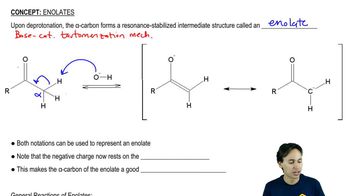
Enolate formation is a key step in acetoacetic ester synthesis, where a base abstracts a proton from the α-carbon of the acetoacetic ester, generating a resonance-stabilized enolate ion. This enolate acts as a nucleophile, allowing it to react with an alkyl halide. Recognizing how to form and stabilize enolates is essential for predicting the outcome of the synthesis.
Recommended video:
Guided course
02:26
Formation of Enolates

Alkyl Halide Selection

The selection of the appropriate alkyl halide is critical in acetoacetic ester synthesis, as it determines the structure of the final ketone product. The alkyl halide must be compatible with the enolate formed from the acetoacetic ester, typically being a primary or secondary halide to minimize steric hindrance. Understanding the reactivity and structure of alkyl halides is vital for successful synthesis.
Recommended video:
Guided course
01:52
How to name alkyl halides