Ch. 17 - Reactions at the Alpha-Carbon
Bruice - Organic Chemistry 8th Edition
Bruice8th EditionOrganic ChemistryISBN: 9780135213711Not the one you use?Change textbook
Chapter 18, Problem 19c

What reagents should be used to prepare the following compounds?
c.

Verified step by step guidance
1
Analyze the target compound: The structure contains two ketone groups. One is part of a cyclohexanone ring, and the other is a methyl ketone group attached to a straight chain. This suggests a synthesis involving two distinct carbonyl groups.
Consider the retrosynthetic approach: Break the molecule into two parts. The cyclohexanone ring can be derived from cyclohexanone, and the methyl ketone group can be introduced via an alkylation or acylation reaction.
Select the starting materials: Cyclohexanone can serve as the precursor for the cyclic ketone. For the straight chain, a suitable alkyl halide (e.g., 1-bromo-3-butanone) can be used to introduce the methyl ketone group.
Choose the reagents for the reaction: Use a strong base like LDA (Lithium Diisopropylamide) to deprotonate cyclohexanone, forming an enolate. This enolate can then react with the alkyl halide in an SN2 reaction to form the desired compound.
Verify the reaction conditions: Ensure that the reaction is carried out under anhydrous conditions to prevent side reactions. The temperature should be controlled to favor the desired product formation.

Verified video answer for a similar problem:

This video solution was recommended by our tutors as helpful for the problem above.
Video duration:
8m
Was this helpful?

Key Concepts

Here are the essential concepts you must grasp in order to answer the question correctly.

Reagents in Organic Synthesis

Reagents are substances used in chemical reactions to facilitate the transformation of reactants into products. In organic synthesis, the choice of reagents is crucial as they determine the reaction pathway, yield, and selectivity of the desired compound. Understanding the role of different reagents, such as acids, bases, oxidizing agents, and reducing agents, is essential for effectively preparing specific organic compounds.
Recommended video:
1:16
Synthesis of Amino Acids: Strecker Synthesis Example 1

Functional Groups

Functional groups are specific groups of atoms within molecules that are responsible for the characteristic chemical reactions of those molecules. Identifying the functional groups present in the target compounds helps in selecting appropriate reagents and reaction conditions. Common functional groups include alcohols, amines, carboxylic acids, and alkenes, each requiring different reagents for their synthesis or transformation.
Recommended video:
Guided course
02:36
Identifying Functional Groups

Reaction Mechanisms

A reaction mechanism is a step-by-step description of the process by which reactants are converted into products. Understanding the mechanism provides insight into how and why certain reagents are used, as well as the conditions necessary for the reaction to proceed. Knowledge of mechanisms, such as nucleophilic substitution or electrophilic addition, is vital for predicting the outcomes of reactions and for designing synthetic pathways.
Recommended video:
Guided course
02:16
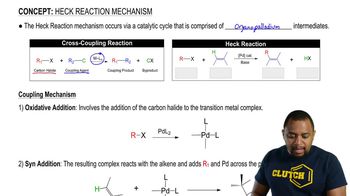
Heck Reaction Mechanism