Ch. 17 - Reactions at the Alpha-Carbon
Bruice - Organic Chemistry 8th Edition
Bruice8th EditionOrganic ChemistryISBN: 9780135213711Not the one you use?Change textbook
Chapter 18, Problem 38c,d,e

Which of the following compounds will decarboxylate when heated?
Structures of three compounds labeled C, D, and E, with a question about their decarboxylation upon heating.

Verified step by step guidance
1
Identify the functional groups in each compound. Decarboxylation typically occurs in compounds containing a carboxylic acid group (-COOH) adjacent to a carbonyl group (C=O) or an electron-withdrawing group.
Analyze compound (i): It contains two ketone groups but lacks a carboxylic acid group. Therefore, it is unlikely to undergo decarboxylation.
Analyze compound (ii): It contains a carboxylic acid group (-COOH) adjacent to a ketone group (C=O). This structure is favorable for decarboxylation when heated.
Analyze compound (iii): It contains a carboxylic acid group (-COOH) but lacks an adjacent carbonyl group or electron-withdrawing group. This structure is less likely to undergo decarboxylation.
Analyze compound (iv): It contains a carboxylic acid group (-COOH) adjacent to a ketone group (C=O). This structure is favorable for decarboxylation when heated.

Verified video answer for a similar problem:

This video solution was recommended by our tutors as helpful for the problem above.
Video duration:
2m
Was this helpful?

Key Concepts

Here are the essential concepts you must grasp in order to answer the question correctly.

Decarboxylation

Decarboxylation is a chemical reaction that involves the removal of a carboxyl group (-COOH) from a compound, resulting in the release of carbon dioxide (CO2). This process is often facilitated by heat and is common in organic reactions involving carboxylic acids or their derivatives. Understanding the conditions under which decarboxylation occurs is crucial for predicting the behavior of compounds when heated.
Recommended video:
Guided course
02:32
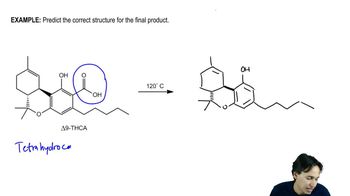
Predict the correct structure

Stability of Carbanions

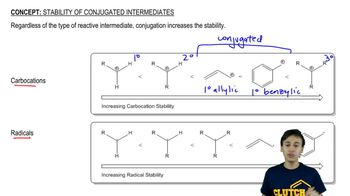
The stability of carbanions, which are negatively charged carbon species, plays a significant role in decarboxylation reactions. A stable carbanion can form during the decarboxylation process, making the reaction more favorable. Factors influencing carbanion stability include resonance, inductive effects, and the presence of electron-withdrawing groups, which can stabilize the negative charge.
Recommended video:
Guided course
04:31
Stability of Conjugated Intermediates

Functional Groups in Organic Compounds

Functional groups are specific groups of atoms within molecules that are responsible for the characteristic chemical reactions of those molecules. In the context of decarboxylation, the presence of carboxylic acid groups (-COOH) is essential, as these groups are the ones that undergo decarboxylation. Identifying functional groups in the given compounds is key to determining which will decarboxylate upon heating.
Recommended video:
Guided course
02:36
Identifying Functional Groups