Ch. 18 - Reactions of Benzene and Substituted Benzenes
Bruice - Organic Chemistry 8th Edition
Bruice8th EditionOrganic ChemistryISBN: 9780135213711Not the one you use?Change textbook
Chapter 19, Problem 45i

Draw the structure for each of the following:
i. m-chlorobenzoic acid

Verified step by step guidance
1
Step 1: Understand the structure of benzoic acid. Benzoic acid consists of a benzene ring (a six-membered aromatic ring with alternating double bonds) attached to a carboxylic acid group (-COOH).
Step 2: Recognize the meaning of the prefix 'm-' (meta). In aromatic chemistry, 'meta' indicates that the substituents on the benzene ring are separated by one carbon atom. This means the substituents are located at positions 1 and 3 on the benzene ring.
Step 3: Identify the substituents. In this case, the substituents are a carboxylic acid group (-COOH) and a chlorine atom (-Cl). The carboxylic acid group is always assigned position 1 on the benzene ring.
Step 4: Place the chlorine atom at the meta position relative to the carboxylic acid group. This means the chlorine atom will be attached to position 3 of the benzene ring.
Step 5: Draw the final structure. Start with a benzene ring, attach the carboxylic acid group (-COOH) to position 1, and attach the chlorine atom (-Cl) to position 3. Ensure the structure reflects the correct meta relationship between the substituents.

Verified video answer for a similar problem:

This video solution was recommended by our tutors as helpful for the problem above.
Video duration:
2m
Was this helpful?

Key Concepts

Here are the essential concepts you must grasp in order to answer the question correctly.

Aromatic Compounds

Aromatic compounds are a class of cyclic compounds that follow Huckel's rule, which states that they must have a planar structure with a specific number of pi electrons (4n + 2). These compounds exhibit unique stability due to resonance, making them distinct from aliphatic compounds. Understanding the structure of aromatic compounds is essential for drawing and interpreting their chemical structures.
Recommended video:
Guided course
08:19
Intro to Aromaticity

Substituent Effects

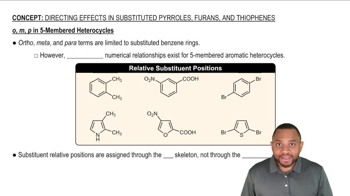
Substituent effects refer to how different groups attached to a benzene ring influence its reactivity and the positions where new substituents can be added. In the case of m-chlorobenzoic acid, the 'm-' indicates that the chlorine atom is in the meta position relative to the carboxylic acid group. Recognizing these effects is crucial for accurately depicting the structure and understanding the compound's chemical behavior.
Recommended video:
2:02
Directing Effects in Substituted Pyrroles, Furans, and Thiophenes Concept 1

Carboxylic Acids

Carboxylic acids are organic compounds characterized by the presence of a carboxyl group (-COOH). This functional group is responsible for the acidic properties of these compounds, as it can donate a proton (H+) in solution. In m-chlorobenzoic acid, the carboxylic acid group is directly attached to the benzene ring, influencing both the compound's structure and its reactivity in organic reactions.
Recommended video:
Guided course
04:20
Carboxylic Acids Nomenclature