Ch. 18 - Reactions of Benzene and Substituted Benzenes
Bruice - Organic Chemistry 8th Edition
Bruice8th EditionOrganic ChemistryISBN: 9780135213711Not the one you use?Change textbook
Chapter 19, Problem 15b

List the compounds in each set from most reactive to least reactive toward electrophilic aromatic substitution:
b. dichloromethylbenzene, difluoromethylbenzene, toluene, chloromethylbenzene

Verified step by step guidance
1
Step 1: Understand the concept of electrophilic aromatic substitution (EAS). EAS involves the attack of an electrophile on an aromatic ring, and the reactivity depends on the substituents attached to the ring. Electron-donating groups (EDGs) increase reactivity, while electron-withdrawing groups (EWGs) decrease reactivity.
Step 2: Analyze the substituents on each compound. Dichloromethylbenzene (CCl3) and difluoromethylbenzene (CF3) are electron-withdrawing groups due to the electronegativity of chlorine and fluorine atoms. Toluene (CH3) and chloromethylbenzene (CH2Cl) are electron-donating groups, with CH3 being a stronger EDG than CH2Cl.
Step 3: Rank the substituents based on their electron-donating or electron-withdrawing effects. CH3 (toluene) is the strongest EDG, followed by CH2Cl (chloromethylbenzene). CCl3 (dichloromethylbenzene) and CF3 (difluoromethylbenzene) are EWGs, with CF3 being more strongly withdrawing than CCl3.
Step 4: Determine the reactivity of the compounds toward EAS. Compounds with EDGs will be more reactive, while those with EWGs will be less reactive. Therefore, the order of reactivity is: toluene > chloromethylbenzene > dichloromethylbenzene > difluoromethylbenzene.
Step 5: Summarize the reasoning. The reactivity order is based on the ability of the substituents to donate or withdraw electrons, which affects the electron density of the aromatic ring and its ability to react with electrophiles.

Verified video answer for a similar problem:

This video solution was recommended by our tutors as helpful for the problem above.
Video duration:
7m
Was this helpful?

Key Concepts

Here are the essential concepts you must grasp in order to answer the question correctly.

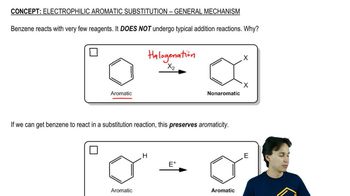
Electrophilic Aromatic Substitution (EAS)

Electrophilic Aromatic Substitution is a fundamental reaction in organic chemistry where an electrophile replaces a hydrogen atom on an aromatic ring. The reactivity of the aromatic compound is influenced by the nature of substituents already present on the ring, which can either donate or withdraw electron density, affecting the stability of the intermediate formed during the reaction.
Recommended video:

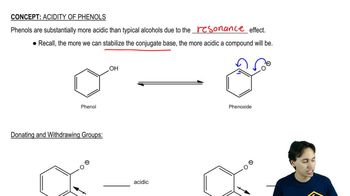
Electron-Withdrawing and Electron-Donating Groups

Substituents on an aromatic ring can be classified as electron-withdrawing groups (EWGs) or electron-donating groups (EDGs). EWGs, such as -CF3 and -Cl, decrease the electron density on the ring, making it less reactive towards electrophiles. In contrast, EDGs, like -CH3 (from toluene), increase electron density, enhancing reactivity in EAS reactions.
Recommended video:
Guided course
02:37
Donating vs Withdrawing Groups

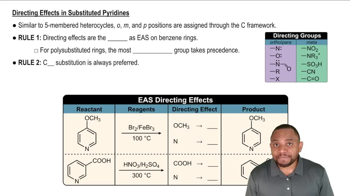
Reactivity Order in EAS

The reactivity order of aromatic compounds in electrophilic aromatic substitution is determined by the electronic effects of substituents. Generally, compounds with EDGs are more reactive than those with EWGs. The presence of multiple substituents can complicate this order, as their combined effects must be considered to accurately predict the reactivity of each compound.
Recommended video:
3:22
EAS Reactions of Pyridine Concept 3