Ch. 18 - Reactions of Benzene and Substituted Benzenes
Bruice - Organic Chemistry 8th Edition
Bruice8th EditionOrganic ChemistryISBN: 9780135213711Not the one you use?Change textbook
Chapter 19, Problem 70c

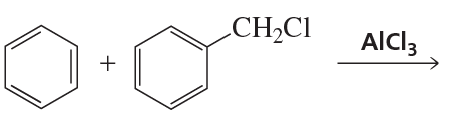
What are the products of the following reactions?
c. Benzene and chloromethylbenzene react with aluminum chloride to illustrate side-chain halogenation.

Verified step by step guidance
1
Identify the type of reaction taking place (e.g., substitution, elimination, addition, oxidation, reduction, etc.) by analyzing the reactants and reaction conditions provided.
Determine the functional groups present in the reactants and how they might interact under the given reaction conditions. For example, if a nucleophile and an electrophile are present, consider a nucleophilic substitution or addition reaction.
Write the mechanism of the reaction step by step, showing how bonds are broken and formed. Use curved arrows to indicate the movement of electrons.
Predict the major product(s) based on the reaction mechanism, considering factors such as regioselectivity (Markovnikov or anti-Markovnikov) and stereoselectivity (syn or anti addition).
Verify the stability of the product(s) by considering resonance, hyperconjugation, and steric effects, and ensure that the reaction follows the expected pathway under the given conditions.

Verified video answer for a similar problem:

This video solution was recommended by our tutors as helpful for the problem above.
Video duration:
2m
Was this helpful?

Key Concepts

Here are the essential concepts you must grasp in order to answer the question correctly.

Reaction Mechanisms

Understanding reaction mechanisms is crucial in organic chemistry as they describe the step-by-step process by which reactants transform into products. This includes identifying intermediates, transition states, and the types of bonds formed or broken during the reaction. Familiarity with mechanisms helps predict the products of reactions based on the nature of the reactants and conditions.
Recommended video:
Guided course
02:16
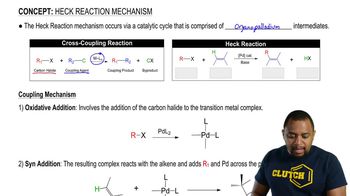
Heck Reaction Mechanism

Functional Groups

Functional groups are specific groups of atoms within molecules that are responsible for the characteristic chemical reactions of those molecules. Recognizing functional groups allows chemists to predict how different compounds will react and what products will form. Common functional groups include alcohols, carboxylic acids, and amines, each influencing reactivity and product formation.
Recommended video:
Guided course
02:36
Identifying Functional Groups

Stoichiometry

Stoichiometry involves the calculation of reactants and products in chemical reactions. It is essential for determining the amounts of substances consumed and produced in a reaction, based on balanced chemical equations. Understanding stoichiometry allows chemists to predict yields and understand the efficiency of reactions, which is vital for both theoretical and practical applications in organic chemistry.
Recommended video:
Guided course
02:08
Organic molecules in your everyday life.