Ch. 18 - Reactions of Benzene and Substituted Benzenes
Bruice - Organic Chemistry 8th Edition
Bruice8th EditionOrganic ChemistryISBN: 9780135213711Not the one you use?Change textbook
Chapter 19, Problem 5e,f

What is the major product of a Friedel–Crafts alkylation using the following alkyl chlorides?
e. (CH3)2CHCH2Cl
f. CH2=CHCH2Cl

Verified step by step guidance
1
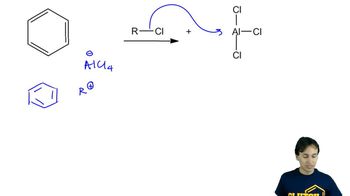
Step 1: Understand the Friedel–Crafts alkylation reaction. This reaction involves the use of an alkyl halide (R-Cl) and a Lewis acid catalyst, such as AlCl₃, to introduce an alkyl group onto an aromatic ring. The reaction proceeds via the generation of a carbocation intermediate.
Step 2: Analyze the alkyl halides provided. For (CH₃)₂CHCH₂Cl (structure ii), the alkyl chloride can form a secondary carbocation after the loss of Cl⁻. For CH₂=CHCH₂Cl (structure i), the allylic carbocation formed is stabilized by resonance due to the adjacent double bond.
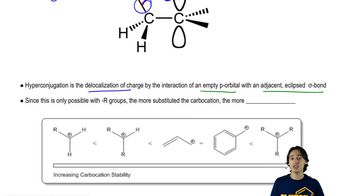
Step 3: Consider carbocation stability. In Friedel–Crafts alkylation, the stability of the carbocation intermediate is crucial. Secondary carbocations (as in ii) are relatively stable, while allylic carbocations (as in i) are even more stable due to resonance stabilization.
Step 4: Predict the major product for each case. For (CH₃)₂CHCH₂Cl, the secondary carbocation will lead to the introduction of an isopropyl group onto the aromatic ring. For CH₂=CHCH₂Cl, the allylic carbocation will lead to the introduction of a propenyl group onto the aromatic ring.
Step 5: Consider regioselectivity and steric effects. The aromatic ring will preferentially react at positions that minimize steric hindrance and maximize electronic stabilization. Typically, the ortho and para positions relative to existing substituents are favored unless steric hindrance is significant.

Verified video answer for a similar problem:

This video solution was recommended by our tutors as helpful for the problem above.
Video duration:
4m
Was this helpful?

Key Concepts

Here are the essential concepts you must grasp in order to answer the question correctly.

Friedel-Crafts Alkylation

Friedel-Crafts alkylation is a reaction that introduces an alkyl group into an aromatic ring using an alkyl halide and a Lewis acid catalyst, typically aluminum chloride. This electrophilic aromatic substitution reaction allows for the formation of new carbon-carbon bonds, enhancing the complexity of aromatic compounds. The choice of alkyl halide can influence the regioselectivity and stability of the product.
Recommended video:
Guided course
06:30
Friedel-Crafts Alkylation

Carbocation Stability

In Friedel-Crafts alkylation, the formation of a carbocation intermediate is crucial. The stability of this carbocation significantly affects the reaction outcome. Tertiary carbocations are more stable than secondary or primary ones due to hyperconjugation and inductive effects, leading to a higher likelihood of substitution at the aromatic ring. Understanding carbocation stability helps predict the major product of the reaction.
Recommended video:
Guided course
05:58
Determining Carbocation Stability

Regioselectivity

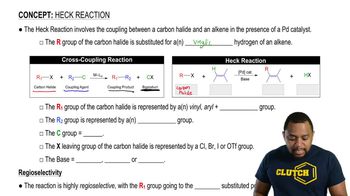
Regioselectivity refers to the preference of a chemical reaction to yield one structural isomer over others. In the context of Friedel-Crafts alkylation, the position where the alkyl group attaches to the aromatic ring can vary based on the stability of the carbocation and the substituents already present on the ring. Recognizing the factors that influence regioselectivity is essential for predicting the major product in reactions involving different alkyl halides.
Recommended video:
Guided course
05:09
Heck Reaction