Ch. 18 - Reactions of Benzene and Substituted Benzenes
Bruice - Organic Chemistry 8th Edition
Bruice8th EditionOrganic ChemistryISBN: 9780135213711Not the one you use?Change textbook
Chapter 19, Problem 25a

What is the major product(s) of each of the following reactions?
a. bromination of p-methylbenzoic acid

Verified step by step guidance
1
Identify the functional groups in p-methylbenzoic acid. The molecule contains a benzene ring with a methyl group (-CH₃) and a carboxylic acid group (-COOH) attached to it in a para (opposite) arrangement.
Understand the directing effects of the substituents. The -CH₃ group is an electron-donating group (activating) and an ortho/para director, while the -COOH group is an electron-withdrawing group (deactivating) and a meta director. However, the -CH₃ group dominates in this case because it is activating.
Determine the reagent and reaction conditions. Bromination typically involves Br₂ in the presence of a catalyst such as FeBr₃, which generates the electrophilic bromine species (Br⁺) required for electrophilic aromatic substitution.
Predict the site of bromination. The bromine will preferentially add to the position ortho to the -CH₃ group (relative to the benzene ring) because the -CH₃ group activates the ortho and para positions. The para position is already occupied by the -COOH group, so bromination occurs at the ortho position relative to the -CH₃ group.
Draw the major product. The major product will be 2-bromo-4-methylbenzoic acid, where the bromine atom is added ortho to the -CH₃ group and the -COOH group remains unchanged.

Verified video answer for a similar problem:

This video solution was recommended by our tutors as helpful for the problem above.
Video duration:
3m
Was this helpful?

Key Concepts

Here are the essential concepts you must grasp in order to answer the question correctly.

Electrophilic Aromatic Substitution

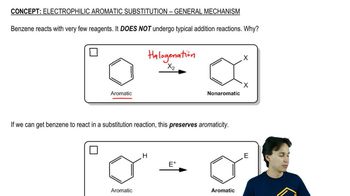
Electrophilic aromatic substitution (EAS) is a fundamental reaction in organic chemistry where an electrophile replaces a hydrogen atom on an aromatic ring. This process is crucial for understanding how substituents on the ring influence the reactivity and orientation of further substitutions. In the case of bromination, the aromatic compound reacts with bromine in the presence of a catalyst, typically iron(III) bromide, to form a brominated product.
Recommended video:

Substituent Effects

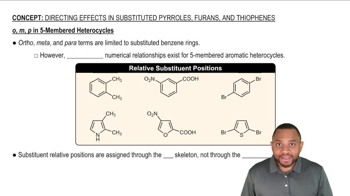
Substituent effects refer to how different groups attached to an aromatic ring can influence the reactivity and position of new substituents. Electron-donating groups, like methyl groups, activate the ring towards electrophilic attack and direct incoming electrophiles to the ortho and para positions. Conversely, electron-withdrawing groups deactivate the ring and direct electrophiles to the meta position. Understanding these effects is essential for predicting the major product of the bromination reaction.
Recommended video:
2:02
Directing Effects in Substituted Pyrroles, Furans, and Thiophenes Concept 1

Bromination Mechanism

The bromination mechanism involves the generation of a bromonium ion, which is a key intermediate in the reaction. In the presence of a Lewis acid catalyst, bromine forms a complex that facilitates the electrophilic attack on the aromatic ring. The stability of the resulting carbocation intermediate and the position of the substituents on the ring will determine the major product formed during the reaction, particularly in the case of p-methylbenzoic acid.
Recommended video:
Guided course
00:54
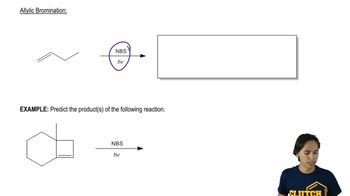
Mechanism of Allylic Bromination.