Ch. 18 - Reactions of Benzene and Substituted Benzenes
Bruice - Organic Chemistry 8th Edition
Bruice8th EditionOrganic ChemistryISBN: 9780135213711Not the one you use?Change textbook
Chapter 19, Problem 73

Which set of underlined hydrogens has its 1H NMR signal at a higher frequency?
a. CH3CH2CH3 or CH3OCH2CH3
b. CH3CH=CH2 or CH3OCH=CH2

Verified step by step guidance
1
Step 1: Analyze the chemical environment of the underlined hydrogens in each molecule. In 1H NMR spectroscopy, the chemical shift is influenced by the electronic environment surrounding the hydrogen atoms. Electronegative atoms, π-bonds, and resonance effects can deshield the hydrogens, causing their signals to appear at higher frequencies (downfield).
Step 2: For part (a), compare CH3CH2CH3 and CH3OCH2CH3. In CH3CH2CH3, the underlined hydrogens are part of a simple alkane chain, experiencing minimal deshielding. In CH3OCH2CH3, the underlined hydrogens are adjacent to an electronegative oxygen atom, which deshields them and shifts their signal to a higher frequency.
Step 3: For part (b), compare CH3CH=CH2 and CH3OCH=CH2. In CH3CH=CH2, the underlined hydrogens are part of an alkene, experiencing deshielding due to the π-electrons of the double bond. In CH3OCH=CH2, the underlined hydrogens are adjacent to both an electronegative oxygen atom and a double bond, leading to even greater deshielding and a higher frequency signal.
Step 4: Consider the inductive and resonance effects in each case. Electronegative atoms like oxygen pull electron density away from nearby hydrogens, increasing their chemical shift. Double bonds also deshield hydrogens due to the anisotropic effect of π-electrons.
Step 5: Conclude that in both comparisons, the molecule containing the oxygen atom (CH3OCH2CH3 and CH3OCH=CH2) will have the underlined hydrogens with a 1H NMR signal at a higher frequency due to the combined effects of electronegativity and resonance.

Verified video answer for a similar problem:

This video solution was recommended by our tutors as helpful for the problem above.
Video duration:
5m
Was this helpful?

Key Concepts

Here are the essential concepts you must grasp in order to answer the question correctly.

Chemical Shift in NMR Spectroscopy

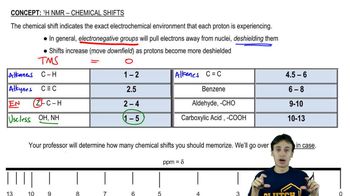
In nuclear magnetic resonance (NMR) spectroscopy, the chemical shift refers to the resonance frequency of a nucleus relative to a standard in a magnetic field. It is influenced by the electronic environment surrounding the nucleus, with electronegative atoms or double bonds causing deshielding, leading to a higher frequency signal. Understanding chemical shifts is crucial for predicting and interpreting NMR spectra.
Recommended video:
Guided course
11:44
1H NMR Chemical Shifts

Electronegativity and Its Effect on NMR

Electronegativity is the tendency of an atom to attract electrons towards itself. In NMR, electronegative atoms (like F or O) can pull electron density away from nearby hydrogen atoms, causing those hydrogens to experience a greater magnetic field and resonate at a higher frequency. This concept is essential for determining which hydrogens will appear at higher frequencies in an NMR spectrum.
Recommended video:
Guided course
1:47
Electronegativity

Alkenes vs. Alkanes in NMR

Alkenes, which contain carbon-carbon double bonds, typically show different NMR signals compared to alkanes, which are saturated hydrocarbons. The presence of a double bond can lead to deshielding effects on adjacent hydrogens, resulting in higher frequency signals. Recognizing the structural differences between alkenes and alkanes is vital for predicting their NMR behavior.
Recommended video:
Guided course
02:47
Functionalizing Alkanes