Ch. 19 - More About Amines • Reactions of Heterocyclic Compounds
Bruice - Organic Chemistry 8th Edition
Bruice8th EditionOrganic ChemistryISBN: 9780135213711Not the one you use?Change textbook
Chapter 20, Problem 1f

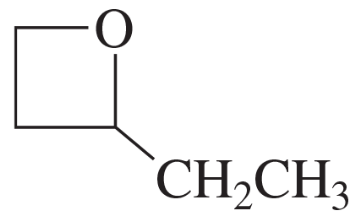
Name the following:
f.

Verified step by step guidance
1
Step 1: Identify the parent structure. The main ring in the structure is a three-membered ring containing an oxygen atom, which is called an epoxide or oxirane.
Step 2: Determine the substituents attached to the parent structure. There are two ethyl groups and two methyl groups attached to the oxirane ring.
Step 3: Assign locants to the substituents. The numbering of the oxirane ring starts at the oxygen atom and proceeds around the ring. The substituents are located on the two carbon atoms of the ring.
Step 4: Name the substituents and their positions. The ethyl groups and methyl groups are named based on their positions relative to the oxirane ring.
Step 5: Combine the substituent names with the parent structure name. Use alphabetical order for the substituents and include the locants to form the complete name of the compound.

Verified video answer for a similar problem:

This video solution was recommended by our tutors as helpful for the problem above.
Video duration:
5m
Was this helpful?

Key Concepts

Here are the essential concepts you must grasp in order to answer the question correctly.

Ethers

Ethers are a class of organic compounds characterized by an oxygen atom connected to two alkyl or aryl groups. They have the general formula R-O-R', where R and R' can be the same or different. Ethers are known for their relatively low reactivity and are commonly used as solvents in organic reactions due to their ability to dissolve a wide range of substances.
Recommended video:
Guided course
04:22
How to predict the products of Ether Cleavage.

Nomenclature of Organic Compounds

The nomenclature of organic compounds follows specific rules set by the International Union of Pure and Applied Chemistry (IUPAC). For ethers, the naming typically involves identifying the two alkyl groups attached to the oxygen atom and combining their names with 'ether' at the end. If the ether is symmetrical, the name can be simplified, while asymmetrical ethers require both groups to be named.
Recommended video:
Guided course
01:40
Defining meso compounds.

Structural Representation

Structural representation in organic chemistry illustrates the arrangement of atoms within a molecule. The image provided shows a specific ether structure, where the oxygen atom is central, connecting two carbon chains. Understanding how to interpret these structures is crucial for identifying functional groups and determining the compound's name and properties.
Recommended video:
Guided course
05:09
Representations of L-Configuration