Ch. 19 - More About Amines • Reactions of Heterocyclic Compounds
Bruice - Organic Chemistry 8th Edition
Bruice8th EditionOrganic ChemistryISBN: 9780135213711Not the one you use?Change textbook
Chapter 20, Problem 26

One of the following compounds undergoes electrophilic aromatic substitution predominantly at C-3, and one undergoes electrophilic aromatic substitution predominantly at C-4. Which is which?

Verified step by step guidance
1
Step 1: Analyze the structures of the two compounds. Both compounds are derivatives of pyridine, which is an aromatic heterocyclic compound. The first compound has a ketone group (C=O) attached to the pyridine ring via an ethyl chain, while the second compound has an amine group (NH) attached to the pyridine ring via an ethyl chain.
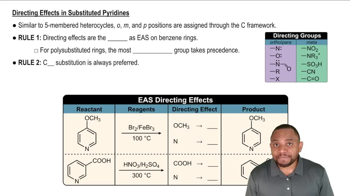
Step 2: Understand the directing effects of the substituents. The ketone group in the first compound is an electron-withdrawing group due to the electronegativity of oxygen and the resonance effect. Electron-withdrawing groups deactivate the aromatic ring and direct electrophilic substitution to the meta position (C-3 relative to the substituent). The amine group in the second compound is an electron-donating group due to the lone pair of electrons on nitrogen. Electron-donating groups activate the aromatic ring and direct electrophilic substitution to the ortho and para positions (C-2 and C-4 relative to the substituent).
Step 3: Predict the predominant site of electrophilic aromatic substitution for the first compound. Since the ketone group is electron-withdrawing, it deactivates the ring and directs substitution to the meta position (C-3).
Step 4: Predict the predominant site of electrophilic aromatic substitution for the second compound. Since the amine group is electron-donating, it activates the ring and directs substitution to the para position (C-4).
Step 5: Summarize the findings. The first compound undergoes electrophilic aromatic substitution predominantly at C-3 due to the electron-withdrawing ketone group, while the second compound undergoes electrophilic aromatic substitution predominantly at C-4 due to the electron-donating amine group.

Verified video answer for a similar problem:

This video solution was recommended by our tutors as helpful for the problem above.
Video duration:
4m
Was this helpful?

Key Concepts

Here are the essential concepts you must grasp in order to answer the question correctly.

Electrophilic Aromatic Substitution (EAS)

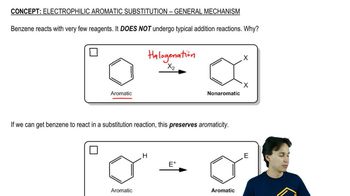
Electrophilic Aromatic Substitution is a fundamental reaction in organic chemistry where an electrophile replaces a hydrogen atom on an aromatic ring. This process is crucial for modifying aromatic compounds and is characterized by the formation of a sigma complex, followed by deprotonation to restore aromaticity. Understanding the regioselectivity of EAS is essential for predicting the position where substitution occurs.
Recommended video:

Regioselectivity in EAS

Regioselectivity refers to the preference of a chemical reaction to occur at one location over another in a molecule. In the context of EAS, the presence of substituents on the aromatic ring can influence the site of electrophilic attack, leading to predominant substitution at specific carbon atoms, such as C-3 or C-4. This is often determined by the electronic effects of the substituents, which can either activate or deactivate certain positions.
Recommended video:
3:22
EAS Reactions of Pyridine Concept 3

Substituent Effects

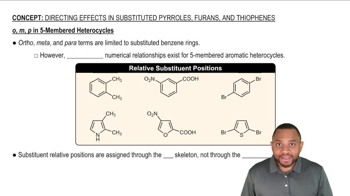
Substituent effects are the influence that different groups attached to an aromatic ring have on its reactivity and the position of electrophilic attack. Electron-donating groups (EDGs) typically direct substitution to ortho and para positions, while electron-withdrawing groups (EWGs) direct it to meta positions. Recognizing these effects is vital for predicting the outcomes of EAS reactions and determining which compound will react at C-3 or C-4.
Recommended video:
2:02
Directing Effects in Substituted Pyrroles, Furans, and Thiophenes Concept 1