Ch. 19 - More About Amines • Reactions of Heterocyclic Compounds
Bruice - Organic Chemistry 8th Edition
Bruice8th EditionOrganic ChemistryISBN: 9780135213711Not the one you use?Change textbook
Chapter 20, Problem 22d

What are the products of the following reactions?
d.

Verified step by step guidance
1
Step 1: Identify the reactants and reagents. The reactants are 2-methylfuran and acetyl chloride (CH3COCl). The reagents are BF3/THF followed by hydrolysis with H2O.
Step 2: Recognize the reaction type. This is an electrophilic aromatic substitution reaction where the furan ring acts as the nucleophile, and acetyl chloride provides the electrophile (acyl group). BF3 acts as a Lewis acid catalyst to facilitate the reaction.
Step 3: Determine the site of substitution. Furan is an aromatic heterocycle, and its electron-rich nature makes it highly reactive towards electrophilic substitution. The most reactive positions are the 2- and 5-positions of the furan ring due to resonance stabilization.
Step 4: Predict the intermediate. The acyl group (CH3CO-) will attach to the 2-position of the furan ring, forming an acylated intermediate. BF3 helps stabilize the transition state during this process.
Step 5: Hydrolysis step. After the acylation, the reaction mixture is treated with water (H2O), which ensures the removal of any remaining BF3 and stabilizes the final product. The final product is 2-acetyl-5-methylfuran.

Verified video answer for a similar problem:

This video solution was recommended by our tutors as helpful for the problem above.
Video duration:
2m
Was this helpful?

Key Concepts

Here are the essential concepts you must grasp in order to answer the question correctly.

Reaction Mechanisms

Understanding reaction mechanisms is crucial in organic chemistry as they describe the step-by-step process by which reactants transform into products. This includes identifying intermediates, transition states, and the movement of electrons. Familiarity with mechanisms helps predict the outcome of reactions and the stability of products formed.
Recommended video:
Guided course
02:16
Heck Reaction Mechanism

Functional Groups

Functional groups are specific groups of atoms within molecules that are responsible for the characteristic chemical reactions of those molecules. Recognizing functional groups is essential for predicting the behavior of organic compounds during reactions, as they dictate reactivity and the types of products formed.
Recommended video:
Guided course
02:36
Identifying Functional Groups

Stereochemistry

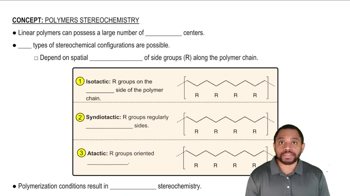
Stereochemistry involves the study of the spatial arrangement of atoms in molecules and how this affects their chemical behavior. It is important for understanding isomerism, where compounds with the same molecular formula can have different structures and properties. This concept is vital when determining the products of reactions, especially in cases involving chiral centers.
Recommended video:
1:38
Polymer Stereochemistry Concept 1