Ch. 19 - More About Amines • Reactions of Heterocyclic Compounds
Bruice - Organic Chemistry 8th Edition
Bruice8th EditionOrganic ChemistryISBN: 9780135213711Not the one you use?Change textbook
Chapter 20, Problem 8

When pyrrole is added to a dilute solution of D2SO4 in D2O, 2-deuteriopyrrole is formed. Propose a mechanism to account for the formation of this compound.

Verified step by step guidance
1
Identify the key components of the reaction: Pyrrole is a five-membered aromatic heterocycle with a nitrogen atom, and D2SO4 in D2O provides a source of deuterium (D⁺) ions for the reaction.
Recognize that the reaction involves electrophilic aromatic substitution (EAS), where a deuterium ion (D⁺) replaces a hydrogen atom on the pyrrole ring. This is due to the aromatic nature of pyrrole, which makes it susceptible to EAS reactions.
Propose the first step of the mechanism: Protonation of the pyrrole nitrogen by D⁺ from D2SO4. This step increases the electron density on the ring, making it more reactive toward electrophilic attack.
Describe the second step: The deuterium ion (D⁺) attacks the pyrrole ring at the 2-position (adjacent to the nitrogen). This position is favored due to resonance stabilization of the intermediate carbocation formed during the reaction.
Explain the final step: The intermediate carbocation loses a proton (H⁺), which is replaced by a deuterium atom from the solvent (D2O), restoring aromaticity and forming 2-deuteriopyrrole as the final product.

Verified video answer for a similar problem:

This video solution was recommended by our tutors as helpful for the problem above.
Was this helpful?

Key Concepts

Here are the essential concepts you must grasp in order to answer the question correctly.

Pyrrole Structure and Reactivity

Pyrrole is a five-membered aromatic heterocycle containing a nitrogen atom. Its structure allows for resonance stabilization, making it a nucleophilic compound. Understanding its reactivity is crucial, as it can participate in electrophilic substitution reactions, particularly in the presence of strong acids like D2SO4.
Recommended video:
1:52
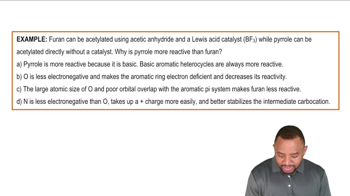
Reactions of Pyrrole, Furan, and Thiophene Example 1

Deuteration

Deuteration is the process of replacing hydrogen atoms in a molecule with deuterium, a heavier isotope of hydrogen. In this context, the reaction involves the substitution of a hydrogen atom in pyrrole with deuterium from D2O. This concept is essential for understanding how isotopic labeling can affect the properties and behavior of organic compounds.

Acid-Catalyzed Mechanisms

Acid-catalyzed mechanisms involve the use of an acid to facilitate a chemical reaction, often by protonating a reactant to make it more electrophilic. In the case of pyrrole and D2SO4, the acid likely protonates the nitrogen, enhancing the electrophilicity of the carbon atoms in the ring, which can then react with deuterium from D2O, leading to the formation of 2-deuteriopyrrole.
Recommended video:
Guided course
06:34
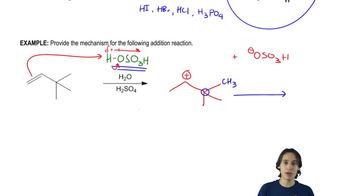
Acid-catalyzed hydration mechanism