Ch. 2 - Acids and Bases: Central to Understanding Organic Chemistry
Bruice - Organic Chemistry 8th Edition
Bruice8th EditionOrganic ChemistryISBN: 9780135213711Not the one you use?Change textbook
Chapter 3, Problem 43c

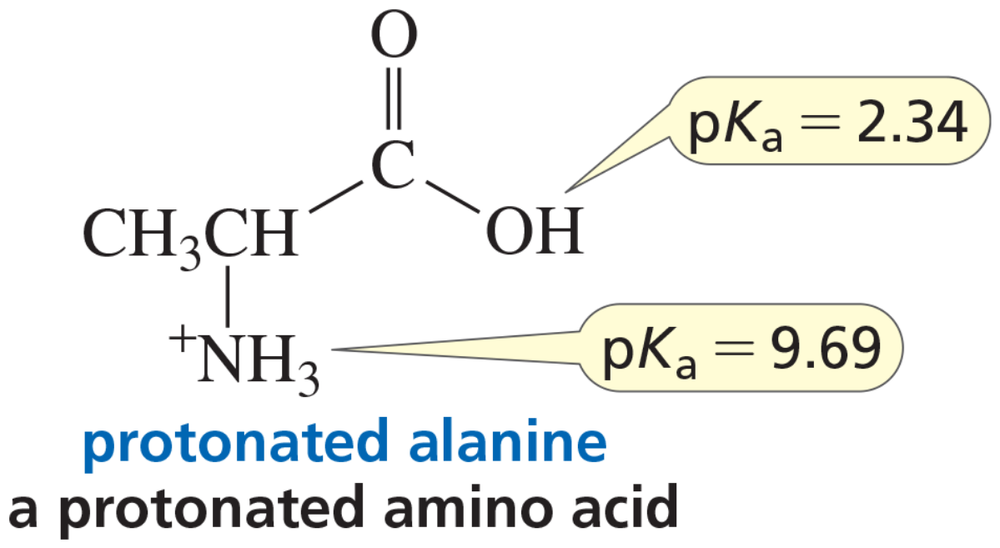
A naturally occurring amino acid such as alanine has a group that is a carboxylic acid and a group that is a protonated amine. The pKa values of the two groups are shown.

c. Draw the structure of alanine in a solution at physiological pH (pH 7.4).

Verified step by step guidance
1
Step 1: Understand the structure of alanine. Alanine is an amino acid with a central alpha carbon bonded to a carboxylic acid group (-COOH), an amine group (-NH2), a hydrogen atom, and a methyl group (-CH3). At physiological pH (7.4), the carboxylic acid group and the amine group will exist in their ionized forms.
Step 2: Analyze the pKa values provided. The pKa of the carboxylic acid group is 2.32, meaning it will lose a proton and exist as a carboxylate ion (-COO⁻) at pH 7.4, which is above its pKa. The pKa of the amine group is 9.62, meaning it will remain protonated as -NH3⁺ at pH 7.4, which is below its pKa.
Step 3: Determine the ionization state of alanine at physiological pH. Since the pH is higher than the pKa of the carboxylic acid group, it will be deprotonated (-COO⁻). Since the pH is lower than the pKa of the amine group, it will remain protonated (-NH3⁺).
Step 4: Draw the structure of alanine at physiological pH. The alpha carbon will be bonded to the following groups: a carboxylate ion (-COO⁻), a protonated amine group (-NH3⁺), a hydrogen atom, and a methyl group (-CH3).
Step 5: Verify the zwitterionic nature of alanine at physiological pH. Alanine exists as a zwitterion, meaning it has both a positive charge (on the -NH3⁺ group) and a negative charge (on the -COO⁻ group) at pH 7.4.

Verified video answer for a similar problem:

This video solution was recommended by our tutors as helpful for the problem above.
Video duration:
4m
Was this helpful?

Key Concepts

Here are the essential concepts you must grasp in order to answer the question correctly.

Amino Acids

Amino acids are organic compounds that serve as the building blocks of proteins. Each amino acid contains a central carbon atom bonded to an amino group (–NH2), a carboxylic acid group (–COOH), a hydrogen atom, and a variable side chain (R group). The properties of the side chain determine the characteristics of the amino acid, influencing protein structure and function.
Recommended video:
Guided course
09:36
Standard Amino Acids

pKa and Acid-Base Chemistry

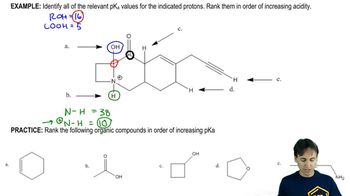
pKa is a measure of the strength of an acid in solution, indicating the pH at which half of the acid is dissociated. In the context of amino acids, the pKa values of the carboxylic acid and the protonated amine groups help determine their ionization states at a given pH. At physiological pH (7.4), the carboxylic acid group is typically deprotonated, while the amine group remains protonated, influencing the overall charge of the amino acid.
Recommended video:
Guided course
07:45
Identifying pKa values

Zwitterion Formation

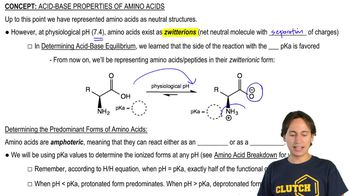
A zwitterion is a molecule that has both positive and negative charges but is overall neutral. In amino acids like alanine at physiological pH, the carboxylic acid group loses a proton (–COO⁻), while the amino group retains a proton (–NH₃⁺). This results in a zwitterionic form, which is crucial for the solubility and reactivity of amino acids in biological systems.
Recommended video:
Guided course
04:41
Why Amino Acids Exist as Zwitterions
Related Practice
Textbook Question

At what pH is the concentration of a compound, with a pKa = 8.4, 100 times greater in its acidic form than in its basic form? At what pH is 50% of a compound, with a pKa = 7.3, in its basic form?

1706
views

Textbook Question

A naturally occurring amino acid such as alanine has a group that is a carboxylic acid and a group that is a protonated amine. The pKa values of the two groups are shown.

d. Draw the structure of alanine in a solution at pH = 12.

1021
views
Textbook Question

A naturally occurring amino acid such as alanine has a group that is a carboxylic acid and a group that is a protonated amine. The pKa values of the two groups are shown.

e. Is there a pH at which alanine is uncharged (that is, neither group has a charge)?

f. At what pH does alanine have no net charge (that is, the amount of negative charge is the same as the amount of positive charge)?

768
views
Textbook Question

Indicate whether an alcohol (ROH) with a pKa value of 15 has more charged or more neutral molecules in a solution with the pH values given in Problem 41.

3. pH = 7

4. pH = 10

5. pH = 13

708
views
Textbook Question

Indicate whether an alcohol (ROH) with a pKa value of 15 has more charged or more neutral molecules in a solution with the pH values given in Problem 41.

1. pH = 1

2. pH = 3

3. pH = 5

1077
views
Textbook Question

Indicate whether a protonated amine (RN+H3) with a pKa value of 9 has more charged or more neutral molecules in a solution with the pH values given in Problem 41.

1. pH = 1

2. pH = 3

3. pH = 5

4. pH = 7

5. pH = 10

6. pH = 13

1101
views