Ch. 2 - Acids and Bases: Central to Understanding Organic Chemistry
Bruice - Organic Chemistry 8th Edition
Bruice8th EditionOrganic ChemistryISBN: 9780135213711Not the one you use?Change textbook
Chapter 3, Problem 16a(3,4)

For each of the acid–base reactions in [Section 2.3], compare the pKa values of the acids on either side of the equilibrium arrows to prove that the equilibrium lies in the direction indicated.
3. <IMAGE>
4. <IMAGE>

Verified step by step guidance
1
Step 1: Identify the acids and bases on both sides of the equilibrium. In the first image, CH3NH2 acts as the acid (donating a proton), and H-O⁻ acts as the base (accepting a proton). In the second image, CH3NH2 acts as the base (accepting a proton), and H3O⁺ acts as the acid (donating a proton).
Step 2: Compare the pKa values of the acids on both sides of the equilibrium. For the first reaction, the pKa of CH3NH2 (acid) is approximately 36, and the pKa of H2O (conjugate acid of H-O⁻) is 15.7. For the second reaction, the pKa of H3O⁺ (acid) is -1.7, and the pKa of CH3NH3⁺ (conjugate acid of CH3NH2) is approximately 10.6.
Step 3: Recall that equilibrium favors the side with the weaker acid (higher pKa value). For the first reaction, the equilibrium lies toward the side with H2O (pKa 15.7) and CH3NH2 (pKa 36). For the second reaction, the equilibrium lies toward the side with CH3NH3⁺ (pKa 10.6) and H2O (pKa 15.7).
Step 4: Analyze the bond-breaking and bond-forming events. In the first image, the bond between CH3NH2 and H breaks, and a new bond forms between H and O⁻. In the second image, the bond between H3O⁺ and H breaks, and a new bond forms between CH3NH2 and H.
Step 5: Summarize the direction of equilibrium based on pKa values. For the first reaction, equilibrium lies to the right (formation of CH3NH2 and H2O). For the second reaction, equilibrium lies to the left (formation of CH3NH3⁺ and H2O).

Verified video answer for a similar problem:

This video solution was recommended by our tutors as helpful for the problem above.
Video duration:
3m
Was this helpful?

Key Concepts

Here are the essential concepts you must grasp in order to answer the question correctly.

Acid-Base Equilibrium

In acid-base chemistry, equilibrium refers to the state where the rates of the forward and reverse reactions are equal. The position of this equilibrium can be predicted by comparing the pK<sub>a</sub> values of the acids involved. The equilibrium will favor the formation of the weaker acid, which has a higher pK<sub>a</sub> value.
Recommended video:
Guided course
04:00
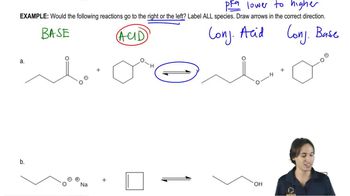
Determining Acid/Base Equilibrium

pK<sub>a</sub> Values

The pK<sub>a</sub> value is a quantitative measure of the strength of an acid in solution. It is the negative logarithm of the acid dissociation constant (K<sub>a</sub>). Lower pK<sub>a</sub> values indicate stronger acids, as they dissociate more completely in solution. This concept is crucial for predicting the direction of acid-base reactions.
Recommended video:
Guided course
06:27
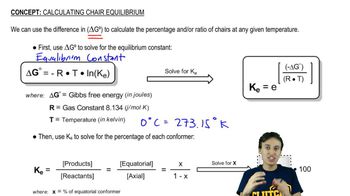
Calculating Chair Equilibrium

Proton Transfer Mechanism

Acid-base reactions often involve the transfer of a proton (H<sup>+</sup>) from the acid to the base. This mechanism can be visualized through reaction arrows indicating the breaking and forming of bonds. Understanding this process is essential for analyzing the reaction and determining the equilibrium position based on the relative strengths of the acids and bases involved.
Recommended video:
3:05
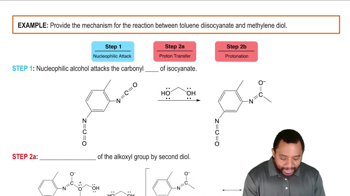
Polyurethane Mechanism Example 1
Related Practice
Textbook Question

Does methanol behave as an acid or a base when it reacts with methylamine?

1744
views

Textbook Question

For each of the acid–base reactions in [Section 2.3], compare the pKa values of the acids on either side of the equilibrium arrows to prove that the equilibrium lies in the direction indicated.

1. <IMAGE>

2. <IMAGE>

1067
views
Textbook Question

Ethyne (HC≡CH) has a pKa value of 25, water has a pKa value of 15.7, and ammonia (NH3) has a pKa value of 36. Draw the equation, showing equilibrium arrows that indicate whether reactants or products are favored, for the acid–base reaction of ethyne with

b. NH2.

c. Which would be a better base to use if you wanted to remove a proton from ethyne, HO or -NH2?

1527
views
Textbook Question

Ethyne (HC≡CH) has a pKa value of 25, water has a pKa value of 15.7, and ammonia (NH3) has a pKa value of 36. Draw the equation, showing equilibrium arrows that indicate whether reactants or products are favored, for the acid–base reaction of ethyne with

a. HO-.

869
views
Textbook Question

a. Which is a stronger base: CH3COO or HCOO? (The pKa of CH3COOH is 4.8; the pKa of HCOOH is 3.8.)

b. Which is a stronger base: HO or -NH2? (The pKa of H2O is 15.7; the pKa of NH3 is 36.)

c. Which is a stronger base: H2O or CH3OH? (The pKa of H3O+ is −1.7; the pKa of CH3O+H2 is −2.5.)

1388
views
Textbook Question

Which of the following bases can remove a proton from acetic acid in a reaction that favors products?

HO CH3NH2 HC≡C  CH3OH H2O Cl

1389
views