Ch. 2 - Acids and Bases: Central to Understanding Organic Chemistry
Bruice - Organic Chemistry 8th Edition
Bruice8th EditionOrganic ChemistryISBN: 9780135213711Not the one you use?Change textbook
Chapter 3, Problem 37

Fosamax (shown on the previous page) has six acidic groups. The active form of the drug, which has lost two of its acidic protons, is shown in the box. 

(Notice that the phosphorus atom in Fosamax and the sulfur atom in [Problem 36] can be surrounded by more than eight electrons because P and S are below the second row of the periodic table.)

a. Why are the OH groups bonded to phosphorus the strongest acids of the six groups?
b. Which of the remaining four groups is the weakest acid?

Verified step by step guidance
1
Step 1: Understand the concept of acidity in organic molecules. Acidity is often related to the ability of a molecule to donate a proton (H⁺). The strength of an acid is determined by the stability of its conjugate base after losing a proton.
Step 2: Analyze the structure of Fosamax. Identify the acidic groups present in the molecule. Typically, these include hydroxyl (OH) groups, carboxylic acids, and other functional groups capable of donating protons.
Step 3: Consider the electronegativity and resonance effects. The OH groups bonded to phosphorus are strong acids because phosphorus can stabilize the negative charge on the conjugate base through resonance and its ability to accommodate more than eight electrons.
Step 4: Evaluate the remaining acidic groups. Compare their ability to donate protons based on factors such as electronegativity, resonance stabilization, and inductive effects. The weakest acid will be the group whose conjugate base is least stabilized.
Step 5: Conclude by identifying the weakest acidic group among the remaining four. Consider the structural features that make this group less likely to donate a proton compared to the others.

Verified video answer for a similar problem:

This video solution was recommended by our tutors as helpful for the problem above.
Video duration:
6m
Was this helpful?

Key Concepts

Here are the essential concepts you must grasp in order to answer the question correctly.

Acidity and Acid-Base Theory

Acidity refers to the ability of a substance to donate protons (H+) in a chemical reaction. According to Brønsted-Lowry acid-base theory, acids are proton donors, and their strength is determined by their ability to dissociate in solution. The more readily a compound donates a proton, the stronger the acid. Understanding the factors that influence acidity, such as electronegativity and resonance stabilization, is crucial for analyzing the acidic behavior of functional groups.
Recommended video:
Guided course
02:49
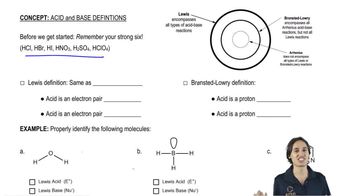
The Lewis definition of acids and bases.

Functional Groups and Their Properties

Functional groups are specific groups of atoms within molecules that are responsible for the characteristic chemical reactions of those molecules. In the case of Fosamax, the presence of hydroxyl (OH) groups bonded to phosphorus significantly influences its acidity. The unique properties of these functional groups, including their ability to stabilize negative charges after deprotonation, play a vital role in determining the overall acidity of the compound.
Recommended video:
Guided course
02:36
Identifying Functional Groups

Electron Configuration and Expanded Octet

Elements in the third period and beyond, such as phosphorus and sulfur, can accommodate more than eight electrons in their valence shell due to the availability of d-orbitals. This phenomenon, known as expanded octet, allows these elements to form stable compounds with more complex bonding arrangements. Understanding this concept is essential for explaining the bonding and reactivity of phosphorus in Fosamax, particularly how it affects the acidity of the OH groups.
Recommended video:
Guided course
02:14
The Electron Configuration