Ch. 2 - Acids and Bases: Central to Understanding Organic Chemistry
Bruice - Organic Chemistry 8th Edition
Bruice8th EditionOrganic ChemistryISBN: 9780135213711Not the one you use?Change textbook
Chapter 3, Problem 24b

Rank the following from strongest base to weakest base:
b. Chemical species listed for ranking from strongest to weakest base: CH3CH2O−, F−, CH3C≡C−, NH2−.

Verified step by step guidance
1
Step 1: Understand the concept of basicity. Basicity refers to the ability of a species to donate a pair of electrons (act as a base). Stronger bases are more willing to donate electrons, while weaker bases are less willing.
Step 2: Analyze the conjugate acids of each base. The strength of a base is inversely related to the strength of its conjugate acid. For example, a weaker conjugate acid corresponds to a stronger base.
Step 3: Consider electronegativity. Fluoride ion (F⁻) is highly electronegative, meaning it holds onto its electrons tightly and is less willing to donate them, making it a weaker base compared to less electronegative species.
Step 4: Evaluate resonance and hybridization effects. CH₃C≡C⁻ (acetylide ion) has sp hybridization, which makes its lone pair more available for donation, increasing its basicity. CH₃CH₂O⁻ (ethoxide ion) and NH₂⁻ (amide ion) are also strong bases, but their basicity is influenced by factors like electronegativity and steric hindrance.
Step 5: Rank the bases from strongest to weakest based on the above considerations: CH₃C≡C⁻ > NH₂⁻ > CH₃CH₂O⁻ > F⁻. This ranking is based on the availability of the lone pair for donation and the stability of the conjugate acid.

Verified video answer for a similar problem:

This video solution was recommended by our tutors as helpful for the problem above.
Video duration:
7m
Was this helpful?

Key Concepts

Here are the essential concepts you must grasp in order to answer the question correctly.

Acidity and Basicity

Acidity and basicity are fundamental concepts in organic chemistry that describe the tendency of a substance to donate or accept protons (H+ ions). A strong base is a substance that readily accepts protons, while a weak base does so less readily. The strength of a base is often determined by its conjugate acid's stability; the weaker the conjugate acid, the stronger the base.
Recommended video:
Guided course
06:21
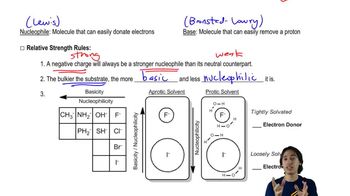
Understanding the difference between basicity and nucleophilicity.

Conjugate Acid-Base Pairs

Conjugate acid-base pairs are related species that differ by the presence of a proton. When a base accepts a proton, it forms its conjugate acid. Understanding these pairs is crucial for ranking bases, as the stability of the conjugate acid influences the base's strength. A stable conjugate acid indicates a weaker base, while an unstable conjugate acid suggests a stronger base.
Recommended video:
2:56
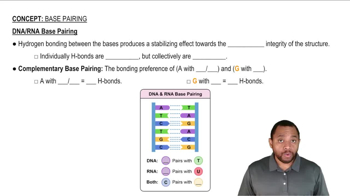
Base Pairing Concept 1

Electronegativity and Atomic Size

Electronegativity refers to the ability of an atom to attract electrons in a bond, while atomic size affects how easily a base can stabilize a negative charge. Generally, bases with less electronegative atoms or larger atomic size can better stabilize the negative charge when they accept protons, making them stronger bases. This concept is essential for comparing the basicity of different compounds.
Recommended video:
Guided course
1:47
Electronegativity