Ch. 20 - The Organic Chemistry of Carbohydrates
Bruice - Organic Chemistry 8th Edition
Bruice8th EditionOrganic ChemistryISBN: 9780135213711Not the one you use?Change textbook
Chapter 21, Problem 4

a. Are d-erythrose and l-erythrose enantiomers or diastereomers?
b. Are l-erythrose and l-threose enantiomers or diastereomers?

Verified step by step guidance
1
Step 1: Understand the definitions of enantiomers and diastereomers. Enantiomers are stereoisomers that are non-superimposable mirror images of each other, while diastereomers are stereoisomers that are not mirror images.
Step 2: Analyze the structures of d-erythrose and l-erythrose. These molecules are mirror images of each other, as the configuration of all chiral centers is opposite. This makes them enantiomers.
Step 3: Examine the structures of l-erythrose and l-threose. These molecules differ in the configuration of one or more (but not all) chiral centers, meaning they are not mirror images. This makes them diastereomers.
Step 4: Confirm the reasoning by comparing the Fischer projections of the molecules. For enantiomers, all chiral centers are inverted, while for diastereomers, only some chiral centers differ.
Step 5: Summarize the findings: d-erythrose and l-erythrose are enantiomers, while l-erythrose and l-threose are diastereomers.

Verified video answer for a similar problem:

This video solution was recommended by our tutors as helpful for the problem above.
Video duration:
2m
Was this helpful?

Key Concepts

Here are the essential concepts you must grasp in order to answer the question correctly.

Enantiomers

Enantiomers are a type of stereoisomer that are non-superimposable mirror images of each other. They typically arise in molecules with chiral centers, where the arrangement of atoms around the chiral carbon differs in such a way that one structure cannot be aligned with its mirror image. For example, D-erythrose and L-erythrose are enantiomers because they differ at all chiral centers.
Recommended video:
Guided course
03:23
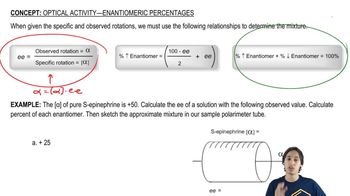
How to solve for the percentage of each enantiomer.

Diastereomers

Diastereomers are stereoisomers that are not mirror images of each other. They occur when two or more chiral centers exist in a molecule, and at least one but not all of the chiral centers differ in configuration. In the case of L-erythrose and L-threose, they are diastereomers because they have different configurations at one of their chiral centers while sharing the same configuration at the other.
Recommended video:
Guided course
03:44
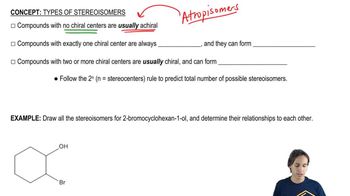
Using chiral centers to predict types of stereoisomers.

Fischer Projections

Fischer projections are a two-dimensional representation of three-dimensional organic molecules, particularly useful for depicting carbohydrates and amino acids. In these projections, vertical lines represent bonds that go behind the plane of the page, while horizontal lines represent bonds that come out of the plane. This format helps in visualizing stereochemistry and determining relationships between different sugars, such as identifying enantiomers and diastereomers.
Recommended video:
Guided course
09:56
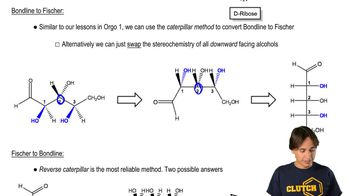
Monosaccharides - Drawing Fischer Projections