Ch. 20 - The Organic Chemistry of Carbohydrates
Bruice - Organic Chemistry 8th Edition
Bruice8th EditionOrganic ChemistryISBN: 9780135213711Not the one you use?Change textbook
Chapter 21, Problem 21

D-Glucose most often exists as a pyranose, but it can also exist as a furanose. Draw the Haworth projection of α-D-glucofuranose

Verified step by step guidance
1
Understand the structure of d-glucose: d-Glucose is an aldohexose, meaning it has six carbons and an aldehyde group at the first carbon. It can cyclize to form either a six-membered pyranose ring or a five-membered furanose ring.
Identify the furanose form: In the furanose form, d-glucose forms a five-membered ring by the reaction of the aldehyde group at C-1 with the hydroxyl group at C-4, creating a hemiacetal.
Determine the alpha (α) configuration: In the α-anomer, the hydroxyl group attached to the anomeric carbon (C-1) is positioned trans (opposite) to the CH2OH group at C-5 in the Haworth projection.
Draw the Haworth projection: Start by sketching a five-membered ring (furanose). Place the oxygen atom at the top of the ring. Assign the substituents to the carbons based on the d-glucose structure: C-1 has the α-hydroxyl group pointing down, C-2 has the hydroxyl group pointing down, C-3 has the hydroxyl group pointing up, and C-4 has the CH2OH group pointing up.
Verify the stereochemistry: Ensure that the stereochemistry of the substituents matches the d-configuration of glucose. The CH2OH group at C-4 should be above the plane of the ring, consistent with the d-configuration.

Verified video answer for a similar problem:

This video solution was recommended by our tutors as helpful for the problem above.
Video duration:
2m
Was this helpful?

Key Concepts

Here are the essential concepts you must grasp in order to answer the question correctly.

Haworth Projection

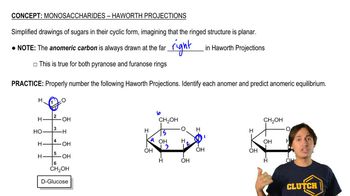
The Haworth projection is a way of representing cyclic sugars in a two-dimensional format that illustrates the cyclic structure of monosaccharides. It shows the orientation of the hydroxyl groups and the anomeric carbon, making it easier to visualize the stereochemistry of the sugar. This representation is particularly useful for understanding the different forms of sugars, such as pyranoses and furanoses.
Recommended video:
Guided course
04:03
Monosaccharides - Haworth Projections

Pyranose vs. Furanose

Pyranose and furanose refer to the two types of cyclic structures that monosaccharides can adopt. Pyranose is a six-membered ring structure, while furanose is a five-membered ring. The formation of these rings occurs through the reaction of the carbonyl group with a hydroxyl group, leading to different chemical properties and reactivity of the sugars.
Recommended video:
Guided course
03:06
1,2 vs. 1,4 products

Anomeric Carbon

The anomeric carbon is the carbon atom in a sugar that was originally part of the carbonyl group (aldehyde or ketone) before the sugar cyclized. In the cyclic form, this carbon becomes a new stereocenter, leading to two possible configurations known as anomers (α and β). The configuration at the anomeric carbon is crucial for determining the sugar's properties and its reactivity in biochemical processes.
Recommended video:
Guided course
02:12
Carbonation of Grignard Reagents