Ch. 21 - Amino Acids, Peptides, and Proteins
Bruice - Organic Chemistry 8th Edition
Bruice8th EditionOrganic ChemistryISBN: 9780135213711Not the one you use?Change textbook
Chapter 22, Problem 11a,b

a. Which amino acid has the lowest pI value?
b. Which amino acid has the highest pI value?

Verified step by step guidance
1
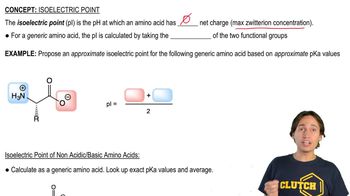
Step 1: Understand the concept of isoelectric point (pI). The pI of an amino acid is the pH at which the amino acid has no net electrical charge. This occurs when the positive and negative charges on the molecule balance each other.
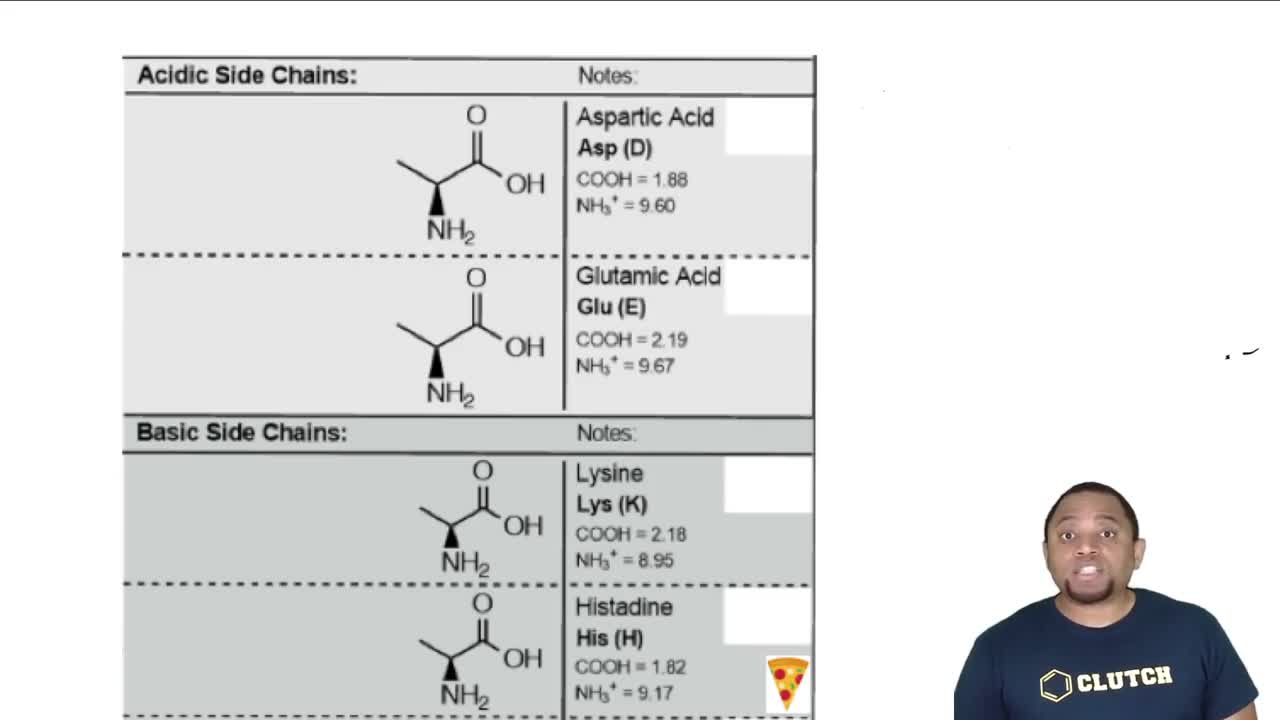
Step 2: Recall that the pI value is influenced by the amino acid's side chain. Acidic amino acids (e.g., aspartic acid and glutamic acid) have lower pI values because their side chains contribute additional negative charges. Basic amino acids (e.g., lysine, arginine, and histidine) have higher pI values due to their positively charged side chains.
Step 3: To determine the amino acid with the lowest pI value, focus on acidic amino acids. These amino acids have carboxylic acid groups in their side chains, which lower the pI value significantly.
Step 4: To determine the amino acid with the highest pI value, focus on basic amino acids. These amino acids have amine groups in their side chains, which increase the pI value significantly.
Step 5: Compare the pI values of all amino acids to identify the one with the lowest pI (likely an acidic amino acid) and the one with the highest pI (likely a basic amino acid). Use reference tables or experimental data for precise values.

Verified video answer for a similar problem:

This video solution was recommended by our tutors as helpful for the problem above.
Video duration:
3m
Was this helpful?

Key Concepts

Here are the essential concepts you must grasp in order to answer the question correctly.

Isoelectric Point (pI)

The isoelectric point (pI) is the pH at which an amino acid exists predominantly in its zwitterionic form, meaning it has no net charge. This value is crucial for understanding the solubility and behavior of amino acids in different pH environments. The pI is determined by the pKa values of the amino acid's ionizable groups, which include the carboxyl and amino groups, as well as any side chain groups that can donate or accept protons.
Recommended video:
Guided course
03:19
Definition of Isoelectric Point

Amino Acid Structure

Amino acids are organic compounds that serve as the building blocks of proteins. Each amino acid has a central carbon atom bonded to an amino group, a carboxyl group, a hydrogen atom, and a variable side chain (R group). The nature of the side chain influences the amino acid's properties, including its pI, as different side chains can have varying pKa values that affect the overall charge of the molecule at different pH levels.
Recommended video:
Guided course
11:14
Charged Amino Acids

pKa Values

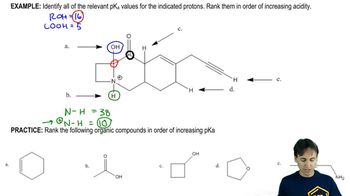
pKa values are a measure of the acidity of a proton in a molecule, indicating the pH at which half of the species are deprotonated. In the context of amino acids, the pKa values of the carboxyl and amino groups, as well as any ionizable side chains, are essential for calculating the pI. Amino acids with side chains that can donate or accept protons will have more complex pI calculations, while those without such groups will have simpler pI values based solely on their terminal groups.
Recommended video:
Guided course
07:45
Identifying pKa values