Ch. 21 - Amino Acids, Peptides, and Proteins
Bruice - Organic Chemistry 8th Edition
Bruice8th EditionOrganic ChemistryISBN: 9780135213711Not the one you use?Change textbook
Chapter 22, Problem 36

Show the steps in the synthesis of the tetrapeptide in Problem 34, using Merrifield's method.

Verified step by step guidance
1
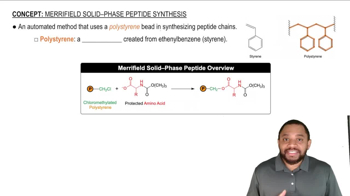
Understand Merrifield's solid-phase peptide synthesis method: This method involves anchoring the C-terminal amino acid of the peptide to an insoluble resin, followed by sequential addition of protected amino acids to build the peptide chain.
Step 1: Attach the first amino acid (C-terminal amino acid of the tetrapeptide) to the resin. Use a protecting group like t-Boc (tert-butyloxycarbonyl) or Fmoc (9-fluorenylmethoxycarbonyl) to protect the amino group of the amino acid. The carboxyl group of the amino acid reacts with the resin to form a covalent bond.
Step 2: Deprotect the amino group of the attached amino acid. For example, if using Fmoc protection, treat the resin-bound amino acid with a base like piperidine to remove the Fmoc group, exposing the free amino group for the next coupling reaction.
Step 3: Couple the next amino acid (with its amino group protected) to the free amino group of the resin-bound amino acid. Use a coupling reagent like DCC (dicyclohexylcarbodiimide) or HATU (hexafluorophosphate azabenzotriazole tetramethyl uronium) to activate the carboxyl group of the incoming amino acid, facilitating peptide bond formation.
Step 4: Repeat the deprotection and coupling steps for the remaining amino acids in the sequence, ensuring the correct order of addition to build the tetrapeptide. After the final amino acid is added, cleave the peptide from the resin and remove any remaining protecting groups to obtain the free tetrapeptide.

Verified video answer for a similar problem:

This video solution was recommended by our tutors as helpful for the problem above.
Video duration:
12m
Was this helpful?

Key Concepts

Here are the essential concepts you must grasp in order to answer the question correctly.

Merrifield Synthesis

Merrifield synthesis is a solid-phase peptide synthesis method that allows for the stepwise assembly of peptides on a solid support. This technique involves attaching the first amino acid to a resin, followed by sequential addition of protected amino acids, which are activated for coupling. The process is efficient and minimizes purification steps, making it a widely used method in peptide chemistry.
Recommended video:
1:53
Merrifield Solid-Phase Peptide Synthesis Concept 1

Amino Acid Protection

In peptide synthesis, amino acids must be protected to prevent unwanted reactions during the coupling process. Protecting groups are temporary modifications that shield reactive functional groups, allowing for selective reactions. Common protecting groups include Fmoc (9-fluorenylmethoxycarbonyl) and Boc (tert-butyloxycarbonyl), which can be removed under specific conditions to reveal the active amino group for further coupling.
Recommended video:
Guided course
09:36
Standard Amino Acids

Peptide Coupling

Peptide coupling is the process of forming a peptide bond between two amino acids, which is essential in peptide synthesis. This reaction typically involves activating the carboxyl group of one amino acid to facilitate its reaction with the amino group of another. Common coupling reagents include DIC (diisopropylcarbodiimide) and HATU (1-Hydroxy-7-azabenzotriazole), which help drive the reaction to completion and improve yield.
Recommended video:
1:24
Peptides Example 1