
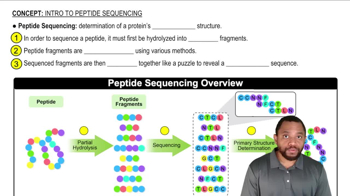
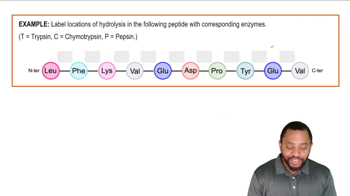
Show the peptides that would result from cleavage by the indicated reagent:
a. Val-Arg-Gly-Met-Arg-Ala-Ser by carboxypeptidase A
b. Ser-Phe-Lys-Met-Pro-Ser-Ala-Asp by cyanogen bromide
c. Arg-Ser-Pro-Lys-Lys-Ser-Glu-Gly by trypsin
Verified step by step guidance
Show the peptides that would result from cleavage by the indicated reagent:
a. Val-Arg-Gly-Met-Arg-Ala-Ser by carboxypeptidase A
b. Ser-Phe-Lys-Met-Pro-Ser-Ala-Asp by cyanogen bromide
c. Arg-Ser-Pro-Lys-Lys-Ser-Glu-Gly by trypsin
Glycine has pKa values of 2.34 and 9.60. At what pH does glycine exist in the forms shown?
a.
How would a protein that resides in the nonpolar interior of a membrane fold compared with the water-soluble protein just discussed?
A decapeptide undergoes partial hydrolysis to give peptides whose amino acid compositions are shown. Reaction of the intact decapeptide with Edman's reagent releases PTH-Gly. What is the sequence of the decapeptide?
1. Ala, Trp
2. Val, Pro, Asp
3. Pro, Val
4. Ala, Glu
5. Trp, Ala, Arg
6. Arg, Gly
7. Glu, Ala, Leu
8. Met, Pro, Leu, Glu
Indicate the peptides produced from cleavage by the indicated reagent:
a. His-Lys-Leu-Val-Glu-Pro-Arg-Ala-Gly-Ala by trypsin
b. Leu-Gly-Ser-Met-Phe-Pro-Tyr-Gly-Val by chymotrypsin
Write the mechanism for the reaction of a cysteine side chain with iodoacetic acid.