
Ch. 21 - Amino Acids, Peptides, and Proteins
Bruice - Organic Chemistry 8th Edition
Bruice8th EditionOrganic ChemistryISBN: 9780135213711Not the one you use?Change textbook
Chapter 22, Problem 52

Which has a higher percentage of negative charge at physiological pH (7.4), leucine with pI = 5.98 or asparagine with pI = 5.43?

Verified step by step guidance
1
Determine the relationship between the pI (isoelectric point) of each amino acid and the physiological pH (7.4). The pI is the pH at which the amino acid has no net charge. If the pH is higher than the pI, the amino acid will carry a net negative charge due to deprotonation of acidic groups.
For leucine (pI = 5.98), compare the physiological pH (7.4) to its pI. Since 7.4 > 5.98, leucine will exist predominantly in a negatively charged form at physiological pH.
For asparagine (pI = 5.43), compare the physiological pH (7.4) to its pI. Since 7.4 > 5.43, asparagine will also exist predominantly in a negatively charged form at physiological pH.
To determine which amino acid has a higher percentage of negative charge, consider the difference between the physiological pH and the pI for each amino acid. A larger difference indicates a greater degree of deprotonation and thus a higher percentage of negative charge.
Compare the differences: For leucine, the difference is 7.4 - 5.98 = 1.42. For asparagine, the difference is 7.4 - 5.43 = 1.97. Since asparagine has a larger difference, it will have a higher percentage of negative charge at physiological pH.

Verified video answer for a similar problem:

This video solution was recommended by our tutors as helpful for the problem above.
Video duration:
1m
Was this helpful?

Key Concepts

Here are the essential concepts you must grasp in order to answer the question correctly.

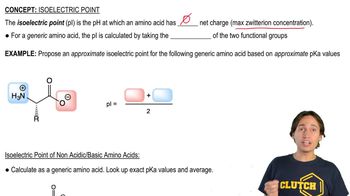
Isoelectric Point (pI)

The isoelectric point (pI) is the pH at which a molecule, such as an amino acid, carries no net electrical charge. At pH values below the pI, the molecule tends to be positively charged, while at pH values above the pI, it tends to be negatively charged. Understanding pI is crucial for predicting the charge state of amino acids at physiological pH.
Recommended video:
Guided course
03:19
Definition of Isoelectric Point

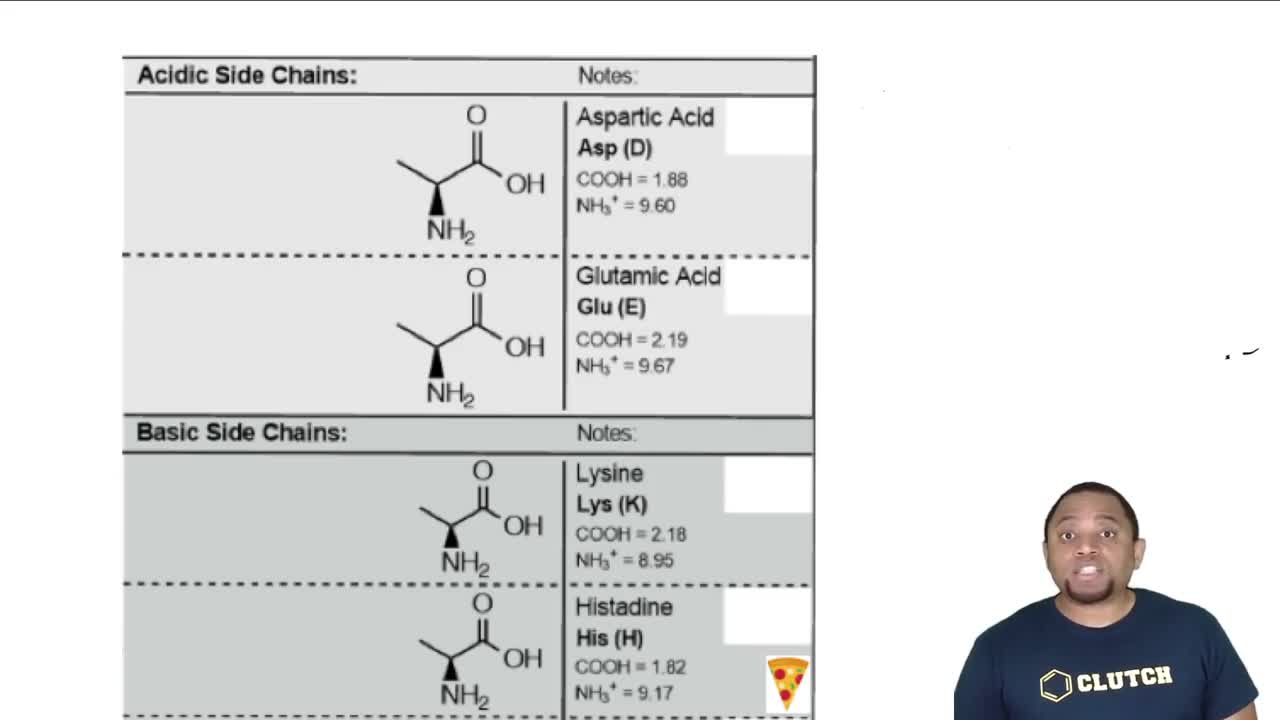
Amino Acid Charge States

Amino acids can exist in different charge states depending on the pH of their environment. At physiological pH (7.4), amino acids with a pI lower than this value will predominantly carry a negative charge, while those with a pI higher will carry a positive charge. This concept is essential for determining the overall charge of amino acids in biological systems.
Recommended video:
Guided course
11:14
Charged Amino Acids

Physiological pH

Physiological pH refers to the typical pH of human blood and tissues, which is approximately 7.4. At this pH, the ionization states of amino acids and other biomolecules can significantly influence their behavior, interactions, and functions in biological processes. Recognizing the implications of physiological pH is vital for understanding biochemical reactions and molecular interactions.
Recommended video:
Guided course
02:15
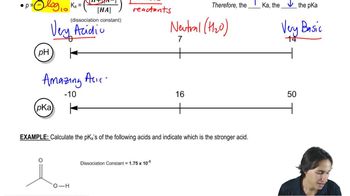
The pH scale vs. the pKa scale.