

Although metal ions increase the rate of decarboxylation of dimethyloxaloacetate, they have no effect on the rate of decarboxylation of either the monoethyl ester of dimethyloxaloacetate or acetoacetate. Explain why this is so.
Ch. 22 - Catalysis in Organic Reactions and in Enzymatic Reactions
All textbooks
Bruice 8th Edition
Ch. 22 - Catalysis in Organic Reactions and in Enzymatic Reactions
Problem 4a
Bruice 8th Edition
Ch. 22 - Catalysis in Organic Reactions and in Enzymatic Reactions
Problem 4aChapter 23, Problem 4a
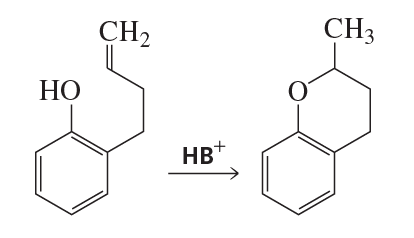
Draw the mechanism for the following reaction if it involves specific-acid catalysis.

Verified step by step guidance1
Identify the functional groups in the reactant and determine the type of reaction taking place (e.g., substitution, addition, elimination, etc.). Specific-acid catalysis typically involves protonation of a functional group to make it more reactive.
Protonate the most likely site on the reactant using a proton (H⁺) from the acid catalyst. This step increases the electrophilicity of the molecule, making it more susceptible to nucleophilic attack or other transformations.
Determine the next step in the mechanism based on the protonated intermediate. For example, if a carbocation is formed, consider whether a nucleophile will attack or if a rearrangement might occur.
Draw the intermediate structures for each step of the reaction, ensuring that all charges and lone pairs are accounted for. Use curved arrows to show the movement of electrons during bond formation and bond breaking.
Conclude the mechanism by showing the final product and regenerating the acid catalyst (if applicable). Verify that the overall reaction is consistent with the principles of specific-acid catalysis.

Verified video answer for a similar problem:
This video solution was recommended by our tutors as helpful for the problem above.
Video duration:
5mWas this helpful?
Key Concepts
Here are the essential concepts you must grasp in order to answer the question correctly.
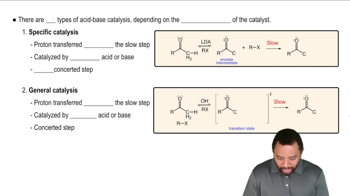
Specific Acid Catalysis
Specific acid catalysis refers to the acceleration of a chemical reaction by the addition of an acid that donates protons (H+) to the reactants. In this process, the acid interacts with the substrate, enhancing its electrophilicity and facilitating the formation of a transition state. This mechanism is crucial in organic reactions, particularly in hydration and esterification, where protonation of functional groups can significantly lower the activation energy.
Recommended video:
Acid-Base Catalysis Concept 3
Reaction Mechanism
A reaction mechanism is a detailed step-by-step description of the pathway through which reactants are converted into products. It outlines the sequence of elementary steps, including bond breaking and formation, and the role of catalysts. Understanding the mechanism is essential for predicting the outcome of reactions and for designing new synthetic pathways in organic chemistry.
Recommended video:
Guided course
Heck Reaction Mechanism
Proton Transfer
Proton transfer is a fundamental process in acid-base chemistry where a proton (H+) is transferred from an acid to a base. In the context of specific acid catalysis, this transfer is often the first step, leading to the activation of the substrate. This concept is vital for understanding how acids can enhance reaction rates and alter the stability of intermediates in organic reactions.
Recommended video:
Guided course
Proton Splitting
Related Practice
Textbook Question
1391
views
Textbook Question
Draw the mechanism if it involves general-acid catalysis.
937
views
Textbook Question
a. Draw the mechanism for the following reaction if it involves specific-base catalysis.
1133
views
Textbook Question
Compare each of the mechanisms listed here with the mechanism for each of the two parts of the acid-catalyzed hydrolysis of an ester, indicating a. similarities. b. differences.
1. acid-catalyzed formation of a hydrate
811
views
Textbook Question
Compare each of the mechanisms listed here with the mechanism for each of the two parts of the acid-catalyzed hydrolysis of an ester, indicating a. similarities. b. differences.
4. acid-catalyzed hydrolysis of an amide
871
views