


Although metal ions increase the rate of decarboxylation of dimethyloxaloacetate, they have no effect on the rate of decarboxylation of either the monoethyl ester of dimethyloxaloacetate or acetoacetate. Explain why this is so.
Ch. 22 - Catalysis in Organic Reactions and in Enzymatic Reactions
All textbooks
Bruice 8th Edition
Ch. 22 - Catalysis in Organic Reactions and in Enzymatic Reactions
Problem 10
Bruice 8th Edition
Ch. 22 - Catalysis in Organic Reactions and in Enzymatic Reactions
Problem 10Chapter 23, Problem 10
Show all the products, including their configurations, that are obtained from the above reaction.
Verified step by step guidance1
Step 1: Analyze the reaction type. Determine whether the reaction is an addition, substitution, elimination, or rearrangement reaction. This will help identify the possible products.
Step 2: Identify the reactants and reagents involved. Look at the functional groups present in the reactants and the nature of the reagents to predict how the reaction will proceed.
Step 3: Consider the stereochemistry of the reaction. If the reaction involves chiral centers or stereoselective steps, determine how the configuration of the products will be affected. Use wedge and dash notation or R/S configuration to represent stereochemistry.
Step 4: Write out the mechanism of the reaction step by step. Show how bonds are broken and formed, and track the movement of electrons using curved arrows. This will help visualize the formation of all possible products.
Step 5: List all the products formed, including their configurations. If multiple stereoisomers are possible, ensure you include each one and specify their stereochemical relationships (e.g., enantiomers, diastereomers).

Verified video answer for a similar problem:
This video solution was recommended by our tutors as helpful for the problem above.
Video duration:
6mWas this helpful?
Key Concepts
Here are the essential concepts you must grasp in order to answer the question correctly.
Reaction Mechanism
A reaction mechanism describes the step-by-step sequence of elementary reactions by which overall chemical change occurs. Understanding the mechanism is crucial for predicting the products of a reaction, as it reveals how reactants are transformed into products, including the formation of intermediates and transition states.
Recommended video:
Guided course
Heck Reaction Mechanism
Stereochemistry
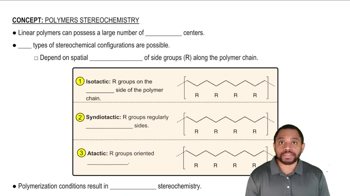
Stereochemistry is the study of the spatial arrangement of atoms in molecules and how this affects their chemical behavior. In organic reactions, the configuration of products can vary based on the stereochemical pathways taken, leading to different isomers, which are critical to identify when showing all products of a reaction.
Recommended video:
Polymer Stereochemistry Concept 1
Functional Groups
Functional groups are specific groups of atoms within molecules that are responsible for the characteristic chemical reactions of those molecules. Recognizing functional groups in reactants helps predict the types of products formed, as different groups can lead to various reaction pathways and product types.
Recommended video:
Guided course
Identifying Functional Groups
Related Practice
Textbook Question
1391
views
Textbook Question
The relative rate of reaction for the cis alkene (E) is given in Table 22.2. What do you expect the relative rate of reaction for the trans alkene to be?
1239
views
Textbook Question
a. Draw the mechanism for the following reaction if it involves specific-base catalysis.
1133
views
Textbook Question
Which of the following C-terminal peptide bonds is more readily cleaved by carboxypeptidase A? Explain your choice.
Ser-Ala-Leu or Ser-Ala-Asp
1194
views
Textbook Question
Why do the nitro groups change the relative leaving tendencies of the carboxy and 2,4-dinitrophenoxy groups in the tetrahedral intermediate in Problem 11?
924
views
Textbook Question
Which of the following amino acid side chains can help remove a proton from the α-carbon of an aldehyde?
3080
views