Aldolase shows no activity if it is incubated with iodoacetic acid before fructose-1,6-bisphosphate is added to the reaction mixture. What causes this loss of activity?
Ch. 22 - Catalysis in Organic Reactions and in Enzymatic Reactions
All textbooks
Bruice 8th Edition
Ch. 22 - Catalysis in Organic Reactions and in Enzymatic Reactions
Problem 31
Bruice 8th Edition
Ch. 22 - Catalysis in Organic Reactions and in Enzymatic Reactions
Problem 31Chapter 23, Problem 31
Which compound has the greatest rate of hydrolysis at pH = 3.5: benzamide, o-carboxybenzamide, o-formylbenzamide, or o-hydroxybenzamide?
Verified step by step guidance1
Identify the functional group in each compound. Benzamide contains an amide group (-CONH2). o-Carboxybenzamide has an amide group and a carboxylic acid group (-COOH) ortho to the amide. o-Formylbenzamide has an amide group and an aldehyde group (-CHO) ortho to the amide. o-Hydroxybenzamide has an amide group and a hydroxyl group (-OH) ortho to the amide.
Understand the mechanism of hydrolysis for amides. Amides hydrolyze in acidic conditions (pH = 3.5) through protonation of the carbonyl oxygen, making the carbonyl carbon more electrophilic and susceptible to nucleophilic attack by water.
Consider the electronic effects of the substituents ortho to the amide group. Electron-withdrawing groups (e.g., -COOH, -CHO) increase the electrophilicity of the carbonyl carbon by withdrawing electron density, thereby accelerating hydrolysis. Electron-donating groups (e.g., -OH) decrease the electrophilicity of the carbonyl carbon, slowing hydrolysis.
Compare the substituents in the given compounds. o-Carboxybenzamide and o-Formylbenzamide have electron-withdrawing groups (-COOH and -CHO, respectively), which enhance the rate of hydrolysis. o-Hydroxybenzamide has an electron-donating group (-OH), which reduces the rate of hydrolysis. Benzamide has no additional substituents, so its hydrolysis rate is unaffected by substituent effects.
Rank the compounds based on their expected hydrolysis rates. The compound with the strongest electron-withdrawing group ortho to the amide group will have the greatest rate of hydrolysis. Compare the effects of -COOH and -CHO to determine which compound hydrolyzes fastest.

Verified video answer for a similar problem:
This video solution was recommended by our tutors as helpful for the problem above.
Was this helpful?
Key Concepts
Here are the essential concepts you must grasp in order to answer the question correctly.
Hydrolysis
Hydrolysis is a chemical reaction involving the breakdown of a compound due to reaction with water. In organic chemistry, hydrolysis often refers to the cleavage of bonds in molecules, such as amides or esters, in the presence of water, leading to the formation of acids and alcohols or amines. The rate of hydrolysis can be influenced by factors such as pH, temperature, and the structure of the compound.
Recommended video:
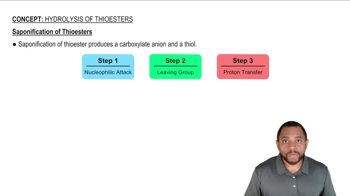
Hydrolysis of Thioesters Concept 2
pH and its Effect on Hydrolysis
pH is a measure of the acidity or basicity of a solution, which can significantly affect the rate of hydrolysis reactions. At lower pH values, such as pH 3.5, the presence of protons (H+) can enhance the hydrolysis of certain compounds, particularly those that can stabilize a positive charge or form a more reactive intermediate. Understanding how pH influences the reactivity of functional groups is crucial for predicting hydrolysis rates.
Recommended video:
Hydrolysis of Thioesters Concept 2
Substituent Effects on Reactivity
The presence of different substituents on a benzene ring can greatly influence the reactivity of compounds in hydrolysis reactions. Electron-withdrawing groups, such as carboxylic acids or hydroxyl groups, can stabilize the transition state or intermediate, thereby increasing the rate of hydrolysis. Conversely, electron-donating groups may decrease reactivity. Analyzing the substituents on the given compounds helps determine which will hydrolyze fastest under acidic conditions.
Recommended video:
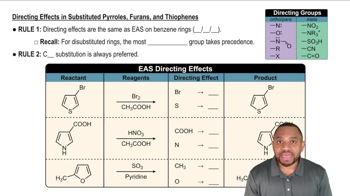
Directing Effects in Substituted Pyrroles, Furans, and Thiophenes Concept 2
Related Practice
Textbook Question
645
views
Textbook Question
Which of the following two compounds eliminates HBr more rapidly in a basic solution?
1342
views
Textbook Question
Which compound forms an anhydride more rapidly?
1044
views
Textbook Question
The deuterium kinetic isotope effect (kH2O/kD2O) for the hydrolysis of aspirin is 2.2. What does this tell you about the kind of catalysis exerted by the ortho-carboxyl substituent? (Hint: It is easier to break an O–H bond than an O–D bond.)
74
views
Textbook Question
Indicate the type of catalysis that is occurring in the slow step in each of the following reaction sequences:
b.
725
views
Textbook Question
Indicate the type of catalysis that is occurring in the slow step in each of the following reaction sequences:
a.
840
views