
Ch. 28 - Pericyclic Reactions
Bruice - Organic Chemistry 8th Edition
Bruice8th EditionOrganic ChemistryISBN: 9780135213711Not the one you use?Change textbook
Chapter 25, Problem 3

a. How many MOs does 1,3,5,7-octatetraene have?
b. What is the designation of its HOMO (c1, c2, etc.)?
c. How many nodes does its highest energy MO have between the nuclei?

Verified step by step guidance
1
Step 1: Determine the number of molecular orbitals (MOs) for 1,3,5,7-octatetraene. The number of MOs corresponds to the number of atomic p orbitals involved in the π-system. Count the number of π-bonds in the molecule and note that each π-bond involves two p orbitals. For 1,3,5,7-octatetraene, there are 4 π-bonds, meaning there are 8 p orbitals, and thus 8 MOs.
Step 2: Identify the designation of the highest occupied molecular orbital (HOMO). The MOs are arranged in increasing energy levels, with the lowest energy MO being bonding and the highest energy MO being antibonding. The HOMO is the highest energy MO that contains electrons. For 1,3,5,7-octatetraene, the MOs are labeled as c1, c2, c3, ..., c8, with c1 being the lowest energy and c8 being the highest. Determine which MO is the HOMO by filling the MOs with the total number of π-electrons (8 π-electrons for this molecule).
Step 3: Assign the designation of the HOMO based on the electron filling. Fill the MOs starting from the lowest energy (c1) and proceed upward, placing two electrons in each MO until all 8 π-electrons are distributed. The last MO to receive electrons is the HOMO. For 1,3,5,7-octatetraene, this will be c4.
Step 4: Determine the number of nodes in the highest energy MO. Nodes are regions where the probability of finding an electron is zero. The number of nodes in an MO increases with its energy level. For a conjugated π-system, the number of nodes in an MO is equal to its energy level minus one. For the highest energy MO (c8), calculate the number of nodes as 8 - 1 = 7.
Step 5: Verify the number of nodes in the HOMO. For the HOMO (c4), calculate the number of nodes as 4 - 1 = 3. This confirms that the HOMO has 3 nodes between the nuclei.

Verified video answer for a similar problem:

This video solution was recommended by our tutors as helpful for the problem above.
Video duration:
6m
Was this helpful?

Key Concepts

Here are the essential concepts you must grasp in order to answer the question correctly.

Molecular Orbitals (MOs)

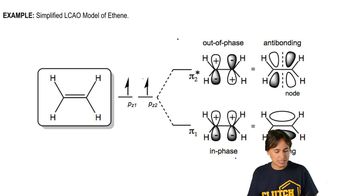
Molecular orbitals are formed by the linear combination of atomic orbitals when atoms bond together. In conjugated systems like 1,3,5,7-octatetraene, the number of MOs corresponds to the number of atomic orbitals involved. For octatetraene, which has eight carbon atoms contributing p orbitals, there will be eight MOs, reflecting the total number of atomic orbitals combined.
Recommended video:
Guided course
08:41
Review of Molecular Orbitals

HOMO and LUMO Designation

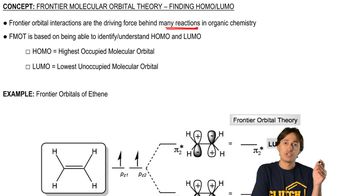
The Highest Occupied Molecular Orbital (HOMO) is the molecular orbital that contains the highest energy electrons in a molecule. In the case of 1,3,5,7-octatetraene, the HOMO can be designated as c1, c2, etc., based on the energy levels of the MOs. The designation helps in identifying the specific orbital that is filled with electrons and is crucial for understanding the molecule's reactivity and electronic properties.
Recommended video:
Guided course
02:35
HOMO vs. LUMO

Nodes in Molecular Orbitals

Nodes are regions in a molecular orbital where the probability of finding an electron is zero. The number of nodes in a molecular orbital can be determined by the formula: number of nodes = n - 1, where n is the principal quantum number of the MO. For the highest energy MO of 1,3,5,7-octatetraene, the number of nodes indicates the complexity of the orbital and its energy, which is essential for predicting the molecule's behavior in chemical reactions.
Recommended video:
Guided course
08:41
Review of Molecular Orbitals