Ch. 28 - Pericyclic Reactions
Bruice - Organic Chemistry 8th Edition
Bruice8th EditionOrganic ChemistryISBN: 9780135213711Not the one you use?Change textbook
Chapter 25, Problem 12b(1,2)

b. Using arrows, show the electron rearrangement that takes place in each reaction.
1.
2.

Verified step by step guidance
1
Step 1: Analyze the first reaction. The starting compound is a conjugated diene with alternating double bonds. The reaction involves heat (Δ), which suggests a pericyclic reaction, specifically a sigmatropic rearrangement.
Step 2: Identify the electron movement in the first reaction. The heat causes a [1,5]-sigmatropic shift, where the π-electrons rearrange. Use curved arrows to show the movement of electrons from one double bond to the next, resulting in the new conjugated diene structure.
Step 3: Analyze the second reaction. The starting compound is a cyclic diene with substituents. The reaction involves heat (Δ), indicating a rearrangement, likely a Cope rearrangement.
Step 4: Identify the electron movement in the second reaction. The Cope rearrangement involves a [3,3]-sigmatropic shift. Use curved arrows to show the movement of electrons from the double bonds and the sigma bond, leading to the new cyclic structure with rearranged substituents.
Step 5: Ensure the electron movement is consistent with the conservation of bonding and the formation of the new products. Verify that the rearranged structures maintain conjugation and stability.

Verified video answer for a similar problem:

This video solution was recommended by our tutors as helpful for the problem above.
Video duration:
7m
Was this helpful?

Key Concepts

Here are the essential concepts you must grasp in order to answer the question correctly.

Electron Movement in Reactions

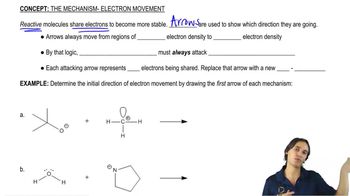
In organic chemistry, understanding how electrons move during chemical reactions is crucial. This movement is often represented by arrows, indicating the flow of electron density from nucleophiles to electrophiles. Recognizing these patterns helps predict the outcome of reactions and the stability of intermediates.
Recommended video:
Guided course
04:03
Learning the rules of electron movement

Nucleophiles and Electrophiles

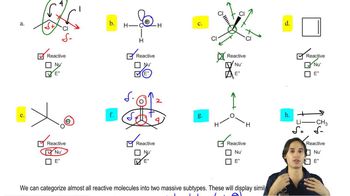
Nucleophiles are species that donate an electron pair to form a chemical bond, while electrophiles are electron-deficient species that accept electron pairs. Identifying these roles in a reaction is essential for understanding how reactants interact and transform into products, guiding the electron rearrangement process.
Recommended video:
Guided course
03:
Nucleophile or Electrophile

Reaction Mechanisms

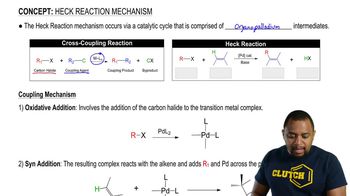
A reaction mechanism outlines the step-by-step process by which reactants convert to products, including the breaking and forming of bonds. Understanding mechanisms is vital for predicting reaction outcomes and understanding the stability of transition states and intermediates, which is often illustrated through electron movement arrows.
Recommended video:
Guided course
02:16
Heck Reaction Mechanism